




Do I need shock-absorbing poles for the steep scree of Scafell Pike?
Scafell Pike, the highest mountain in England, is famous for its vast, shifting scree slopes—particularly on the approach from Wasdale Head or the notorious gully below the summit. If you're planning to tackle this iconic peak, you've probably wondered whether investing in shock‑absorbing trekking poles will make the descent easier on your knees. The short, definitive answer is no—for steep, loose scree, shock‑absorbing poles are not only unnecessary but can actually be a disadvantage. In this detailed guide, we'll explain why rigid poles outperform shock models on unstable terrain, and give you the technical knowledge to choose the right equipment for a safe, controlled Scafell Pike experience.
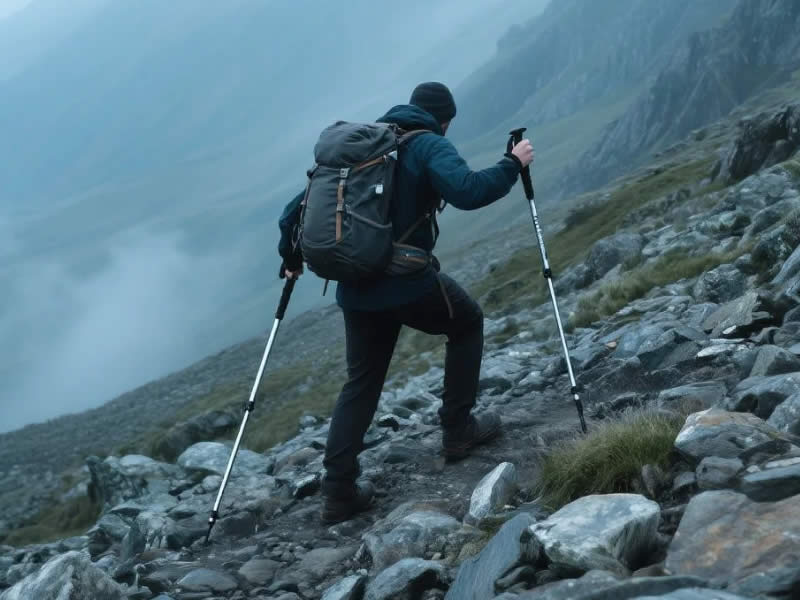
1. Understanding Scree – Why It Demands Precision
Scree is composed of countless loose, angular rocks that shift underfoot with every step. On Scafell Pike, the scree is particularly notorious: it ranges from golf‑ball‑sized gravel to dinner‑plate‑sized slabs, all sitting at an angle of 30‑40 degrees. Walking on scree requires two key actions:
- Testing each step – You need to probe the surface to find a stable rock before committing your weight.
- Controlled glissading – On the descent, you often slide down the scree in a controlled ski‑like motion, using your poles to brake and steer.
In both scenarios, instant, un‑dampened feedback from the pole tip is essential. Your hands and wrists act as sensors; they tell you whether the tip has hit a firm rock or is sinking into loose material. A shock absorber, by its very design, filters out that micro‑vibration—it literally "absorbs" the very information you need. This delay in tactile feedback can cause you to misjudge a placement, leading to a stumble or a fall.
2. The Problem with Springs on Descent
When you descend steep scree, you typically lean back and use your poles as out‑riggers, planting them well ahead of your body to create a stable tripod. Each plant drives the tip into the moving scree. With a shock‑absorbing pole:
- The spring compresses – Instead of delivering a solid stop, the shaft sinks a centimetre or two as the spring yields. This reduces your braking effectiveness, allowing your body to slide forward faster.
- It creates a rhythm mismatch – The spring's rebound pushes back against your hand at a different timing than the ground contact, making your movements feel spongy and less controlled.
- It bottoms out – On a really hard plant, the spring compresses fully, and you get a sudden, jarring metal‑on‑metal stop, which is actually harsher than a rigid pole's clean impact.
Many experienced Lake District walkers report that shock absorbers make descending scree feel "woolly" and "unpredictable." In contrast, a rigid pole gives a crisp, immediate stop that you can trust.
3. Why Rigid Poles Excel on Scree
Rigid (non‑shock) poles provide:
- Direct force transfer – Every push translates instantly into forward or braking momentum, giving you precise control over your speed.
- Accurate placement feedback – You feel the exact texture and stability of the rock under the tip, allowing you to adjust your foot placement accordingly.
- Simpler mechanics – There are no springs, seals, or moving internal parts to fail. When you're grinding down a scree slope, grit and dust can easily infiltrate a shock mechanism, causing it to jam or lose damping. Rigid poles just keep working.
- Lighter weight – Removing the shock unit saves about 50‑100g per pole, which is noticeable on a long ascent.
4. What About Lockable Shocks?
Some trekking poles feature a switch that locks the shock absorber, turning it into a rigid pole. If you already own such a pair, that's perfectly fine—you can simply engage the lock before you enter the scree zone. However, if you're buying new poles specifically for Scafell Pike, paying extra for a feature you'll disable on the mountain's most challenging section is not a wise investment. You're better off putting that budget into a stronger shaft material or a better locking mechanism.
5. The Ideal Pole for Scafell Pike's Scree
Based on the terrain and the arguments above, the best pole for Scafell Pike's steep scree is a 3‑section, rigid aluminium pole with these specific features:
- Material – 7075‑T6 aluminium, for its strength and ability to bend (not shatter) if wedged between rocks.
- Shaft diameter – At least 18 mm in the lower section, to resist buckling when you plant firmly on unstable ground.
- Locking mechanism – Flip‑locks (cam‑locks) with metal cams, because they can be adjusted and tightened even if grit gets in the clamp area. Twist‑locks are prone to slipping under the heavy, repeated shocks of scree descent.
- Tip – Tungsten‑carbide with a sharp, aggressive profile. Some walkers prefer a slightly blunter tip for scree, as it doesn't penetrate as deeply and allows for quick, skimming placements—but a sharp tip still works well if you plant vertically.
- Basket – Small or medium‑sized baskets are fine; large snow baskets are unnecessary and can catch on rocks.
Models like the Black Diamond Trail Pro, Leki Makalu, or the Komperdell Titan are all excellent, reliable choices for this type of terrain.
6. Technique – More Important Than the Pole Type
Even with the best rigid poles, your technique will determine your safety on scree. Here are some field‑proven tips for Scafell Pike's steep slopes:
- Shorten your poles for descent – Reduce the length by 5‑10 cm from your normal walking setting. This gives you a lower centre of gravity and better leverage for braking.
- Plant with a "stabbing" motion – Drive the tip firmly into the scree at a slight angle, so it digs in rather than skidding.
- Use both poles as brakes – Alternate between left and right plants to control your speed, mimicking a skiing "wedge" motion.
- Let your heels dig in – On the descent, walk with a slightly flat foot, allowing your heels to plough into the scree. Use the poles to maintain balance, not to support your full weight.
- Keep your hands relaxed – A tense grip transmits shock to your wrists; let the poles do the work.
7. The Verdict – Save Your Money, Choose Rigid
To directly answer the question: No, you do not need shock‑absorbing poles for the steep scree of Scafell Pike. The terrain demands precision, instant feedback, and predictable braking—all of which rigid poles provide better. Shock absorbers blur that crucial feedback and can even destabilise you on loose ground. If you already have shock poles, lock them rigid before you hit the scree. If you're buying new, invest in a high‑quality rigid aluminium pair with flip‑locks and a carbide tip. Your knees will thank you on the descent, and your confidence will remain high as you navigate one of England's most exhilarating and challenging mountain environments.




