




Best poles for the challenging "Striding Edge" approach in the Lake District?
When tackling Striding Edge – the legendary, knife‑edged arête on Helvellyn – the question of trekking poles is a delicate one. Use the wrong poles and you'll be a clumsy, unbalanced mess; use the right ones and you'll stride confidently up the steep, boggy approach, then stow them effortlessly for the exposed scramble. The short answer is: the best poles are ultralight, packable folding poles – designed to get you to the start of the ridge with fresh legs, then disappear into your pack while you use your hands on the rock.
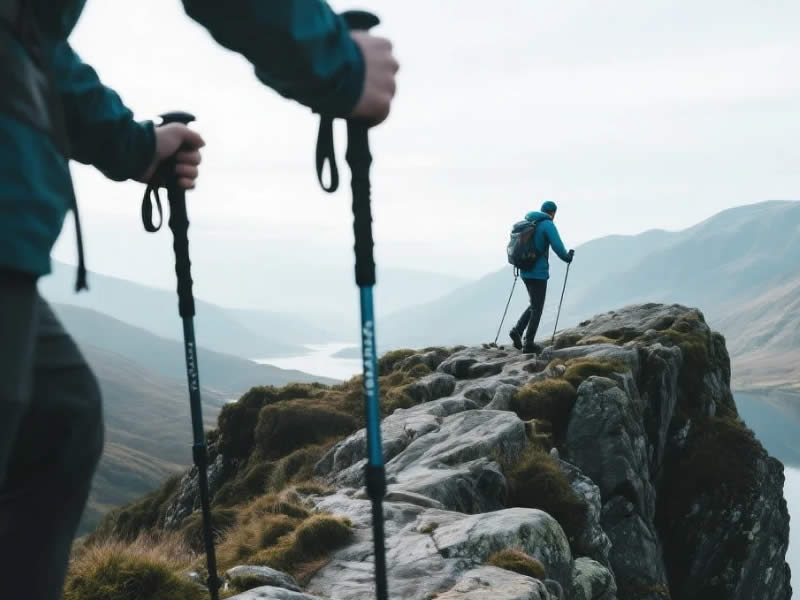
Why the approach demands specific poles
The classic Striding Edge circuit starts from Glenridding or Patterdale. The ascent to the edge itself is a sustained, steep pull over grassy, often saturated slopes, interspersed with patches of wet rock and loose scree. You'll be grateful for the stability and knee‑saving braking that poles provide – especially on the descent, when you return via the Swirral Edge or the longer, wearying path.
However, once you reach the crest of Striding Edge – a narrow, rocky ridge with exposed drops on both sides – any poles become a dangerous hindrance. You need both hands free for scrambling, and even a collapsed pole swinging from your wrist can throw off your balance. The ideal pole, therefore, must be:
- Light enough that you barely notice it when carried.
- Collapsible to a very short length (under 40 cm) to fit inside or securely attach to a small daypack.
- Quick to deploy and stow – because you'll be switching between approach and scramble several times.
- Durable enough for the wet, rocky, and muddy terrain, without being overbuilt and heavy.
The top recommendation: ultralight folding (Z‑style) poles
Folding poles, also known as Z‑poles or three‑section collapsible poles, are the undisputed champions for this job. They break down into three equal sections connected by an internal cord, and they snap together in seconds with a button or a cam lock. Here's why they excel:
- Packability – At around 30–40 cm collapsed, they fit neatly inside a 25‑litre pack or alongside it, without poking out and snagging on crags.
- Low weight – Most quality folding poles weigh between 150–230 g per pole, which is a blessing when you're carrying them for the four‑hour ridge walk.
- Instant setup – With a simple flick of the wrist, they lock rigidly, ready for the steep approach.
- Adequate strength – While not for heavy side‑loading, they handle the vertical loads of a normal walk with ease.
Which models stand out for the Lake District?
Based on field tests and recommendations from local guides, these are the top performers:
- Black Diamond Distance Z – The classic. Available in aluminium (sturdy) or carbon (lighter). The SpeedLock deploy is foolproof, and the foam grip is comfortable in wet weather. The aluminium version offers the best balance of durability and weight for the rocky Lakeland terrain.
- Leki Micro Vario – A clever hybrid: the lower two sections fold, while the upper section telescopes, allowing fine length adjustment. This is invaluable because the approach varies from steep grass to stream‑crossings, and you'll want to change length on the fly. At ~190 g per pole, it's incredibly light.
- Fizan Compact – A budget‑friendly alternative using aluminium, with a simple push‑button lock. It collapses to 38 cm and weighs about 220 g. Perfect for occasional scramblers who don't want to spend a fortune.
All three come with sharp tungsten‑carbide tips for grip on wet rock, and most have small baskets that stop the poles sinking into the peat – though you might remove the baskets for the rocky sections to reduce snagging.
Key features to look for
When choosing your Striding Edge poles, prioritise:
- Flip‑locks (cam locks) over twist‑locks – they're quicker and more reliable when you're adjusting with cold, wet hands.
- A comfortable grip – cork or foam, shaped to your hand, with a good extension for choking up on steep uphill sections.
- Carbide tips – essential for the wet rock on the upper approach.
- Rubber tip protectors – useful for the initial road walk from the car park, but you'll remove them for the fell.
- A secure stowage option – either a dedicated pole‑holder on your pack or elastic cords to lash them horizontally across the top.
Technique for the approach and transition
- Set the right length – For the ascent, shorten your poles by 5 cm from your normal flat‑walk length; for the descent (if you're coming back a different way), lengthen them by 5 cm.
- Plant vertically – On the steep grass, keep the shaft as upright as possible to maximise grip and avoid side‑loading.
- Stow before the ridge – As you approach the foot of Striding Edge, stop, collapse your poles, and attach them securely to your pack. Ensure they won't swing loose while you're scrambling.
- Retrieve them after – Once you've crossed the ridge and reached Helvellyn's summit plateau, you can redeploy them for the descent – but remember to adjust length for the downhill.
What not to use
- Telescopic poles – Even collapsed to their shortest (typically 60–70 cm), they're too long to pack neatly. They'll swing against your legs or catch on rocks, distracting you on the exposed ridge.
- Heavy, all‑metal poles – Their weight will exhaust you on the carry, and their bulk will make stowage awkward.
- Cheap, unbranded folding poles – They often have weak locking pins or soft alloy that can bend under normal load. On Striding Edge, you can't afford a failure.
The verdict – invest in quality, packable poles
For the challenging Striding Edge approach, ultralight folding poles are the definitive choice. They give you the support you need for the demanding climb, yet they vanish into your pack when you need free hands for the scramble. Models like the Black Diamond Distance Z, Leki Micro Vario, or Fizan Compact are proven performers. Remember: the best pole is one you can trust and one that doesn't get in the way. With the right pair, you'll conquer the approach with ease, enjoy the exhilaration of the ridge, and descend with knees intact – a perfect day in the Lake District.




