




Can I use trekking poles for Nordic walking UK?
Walk through any British park or towpath, and you’ll spot Nordic walkers gliding along with their distinctive poles – straight grips, glove‑like straps, and a rhythmic, full‑body stride. If you already own a pair of trekking poles, it’s tempting to think: they’re just poles, right? The short answer is yes, you can physically use trekking poles for Nordic walking – but they are not ideal, and they won’t deliver the full benefits of the technique. This guide explains the differences, the compromises you’ll make, and when it’s worth investing in purpose‑built Nordic walking poles.
What is Nordic walking?
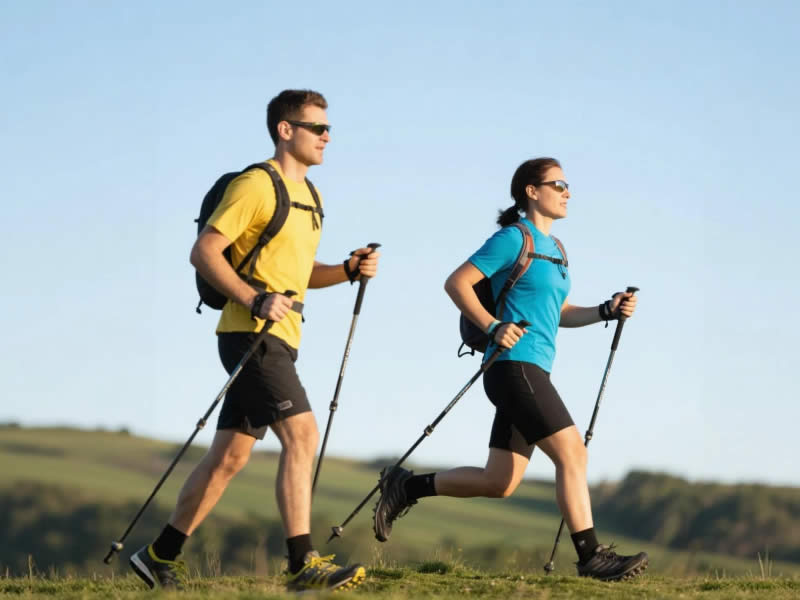
Nordic walking originated in Finland as a summer training method for cross‑country skiers. It involves walking with specially designed poles while maintaining a diagonal gait – left pole with right foot, right pole with left foot – and actively pushing backwards through the poles with each stride. The technique engages the upper body (shoulders, back, and core) alongside the legs, increasing calorie burn by up to 20‑30% compared to regular walking.
The poles are not just for balance – they are propulsion tools, and their design reflects that purpose.
Trekking poles vs. Nordic walking poles – the key differences
| Feature | Trekking poles | Nordic walking poles |
|---|---|---|
| Grip angle | Angled or curved (ergonomic) | Straight, with a forward rake |
| Strap system | Simple wrist loop | Glove‑like, integrated “power strap” |
| Length adjustment | Highly adjustable (telescopic) | Fixed length (sized to height) |
| Weight | 240‑280g each (aluminium) | 150‑200g (usually carbon/light alloy) |
| Shaft flexibility | Stiff to rigid | Slightly flexible for shock absorption |
| Baskets | Interchangeable (mud/snow) | Smaller, low‑profile |
| Tip design | Carbide tip (durable for rocks) | Carbide tip with a slight angle for grip |
The most significant difference is how you hold and push. Trekking poles have a grip that leans forward – your wrist naturally bends to plant the pole ahead, which is perfect for uphill thrust and braking on descents. Nordic poles have a straight grip that encourages a handshake‑like hold, with your palm open and the strap doing most of the work during the backward push.
The technical problem – why trekking poles don't transfer well
1. Grip angle – the wrist strain issue
With trekking poles, your wrist is slightly flexed when you plant the pole ahead. For Nordic walking, you need a straight wrist and a relaxed hand that opens and closes naturally with each stride. Using angled grips forces you to bend your wrist unnaturally during the backward push, which can lead to wrist strain, tennis elbow, or even carpal tunnel syndrome over time.
2. Strap system – limited power transfer
Nordic walking poles use a rigid strap that wraps around your thumb and the back of your hand. When you push, you open your hand and the strap transmits the force directly from your arm through the pole. Trekking pole straps are simple loops – you grip the handle tightly, and the strap only provides a backup in case you drop the pole. You cannot achieve the same efficient power transfer without a dedicated system.
3. Length – fixed for a reason
Nordic walking requires a fixed length – typically determined by multiplying your height (in cm) by 0.68. The pole should reach the ground when your elbow is at 90° and your forearm is horizontal. Trekking poles are adjustable, which seems convenient, but the constant temptation to alter length during a Nordic walk disrupts the consistent stride rhythm. For true Nordic technique, you want a pole that doesn't change.
4. Weight distribution
Nordic poles are lighter (150‑180g) because you swing them continuously – heavier trekking poles (240‑280g) will tire your arms and shoulders much faster. The extra weight also affects the speed of your arm swing, making it harder to maintain the required cadence.
5. Baskets and tips
Nordic walking uses small, low‑profile baskets that don’t interfere with the stride. Trekking poles often come with larger mud baskets – they can catch on grass or brush and disrupt your rhythm. The tips are also different: Nordic tips have a subtle angle to grip the ground during the push, whereas trekking tips are straight and designed for piercing rocky surfaces.
Can you make it work – and how?
If you already have trekking poles and want to try Nordic walking without buying new gear, here are some compromises:
- Set your poles to a fixed length – lock them at the length determined by your height (height in cm × 0.68). Don't change it during the session.
- Adjust your grip – hold the pole with your wrist in a neutral (straight) position, even if the grip is angled. This may require you to hold the pole slightly higher or lower than the designated grip zone.
- Use a looser grip – Nordic walking relies on an open hand during the push. With trekking poles, practice letting the strap take the weight and relaxing your fingers – but you won't get the full “glove” effect.
- Use small baskets – if your poles came with snow baskets or no baskets, consider buying low‑profile baskets that minimise drag.
Expect: less power transfer, quicker fatigue in your forearms, and a less fluid motion. Many people do use trekking poles for light, recreational Nordic walking – especially on gentle, flat terrain – and they still enjoy the extra arm movement. But for proper technique and long‑term comfort, it's a compromise.
When to invest in dedicated Nordic walking poles
If you plan to:
- Walk more than twice a week with Nordic technique.
- Take part in Nordic walking classes or group sessions (where technique is emphasised).
- Walk on varied terrain (hills, uneven ground) – dedicated poles give better control.
- Avoid wrist or elbow discomfort – the ergonomic design is safer.
Then it's worth investing in proper Nordic poles. Entry‑level models cost £50‑80 (e.g., Leki, Exel, or Decathlon’s own brand). Premium carbon models are £100‑150. They come sized to your height, with correct straps, grips, and tips – ready to use straight away.
UK retailers and guidance
In the UK, Nordic walking is often organised by instructors affiliated with British Nordic Walking or Nordic Walking UK. They offer technique workshops and can advise on pole sizing. Shops like Decathlon, Cotswold Outdoor, and Tiso stock both trekking and Nordic poles – you can compare them side‑by‑side.
Many local councils and health centres also run Nordic walking groups – they often have demo poles you can try before buying.
The final verdict
| Your goal | Recommendation |
|---|---|
| Occasional gentle walk – already have trekking poles | Use them – they'll give you some upper‑body activity, even if technique isn't perfect. |
| Regular Nordic walking (2‑3x/week) | Buy dedicated poles – your wrists, elbows, and enjoyment will improve. |
| Formal classes or long distances | Dedicated poles essential – you'll get the full calorie‑burn and rhythm. |
| Hillwalking first, occasional Nordic as a cross‑train | Keep trekking poles – they're better for your primary activity. |
A practical note on technique – if you use trekking poles for Nordic
If you do use trekking poles, remember:
- Plant the pole at a sharper angle – closer to your body than you would for hillwalking.
- Push backwards, not downwards – your arm should finish behind your hip, not beside it.
- Open your hand on the push – let the strap do the work, even if it's a simple loop.
- Keep your shoulders relaxed and down – don't shrug.
Over to you
Yes, you can use trekking poles for Nordic walking in the UK – but they are a compromise, not a replacement. For a taster session or a casual park walk, they'll do. But if you catch the Nordic walking bug, invest in the right tool. Your body will thank you, and you'll discover the joy of a flowing, full‑body stride that trekking poles simply can't replicate. Happy walking – whichever pole you choose. (Word count: ~1,100)
Can I use trekking poles for Nordic walking UK?
Walk through any British park or towpath, and you’ll spot Nordic walkers gliding along with their distinctive poles – straight grips, glove‑like straps, and a rhythmic, full‑body stride. If you already own a pair of trekking poles, it’s tempting to think: they’re just poles, right? The short answer is yes, you can physically use trekking poles for Nordic walking – but they are not ideal, and they won’t deliver the full benefits of the technique. This guide explains the differences, the compromises you’ll make, and when it’s worth investing in purpose‑built Nordic walking poles.
What is Nordic walking?
Nordic walking originated in Finland as a summer training method for cross‑country skiers. It involves walking with specially designed poles while maintaining a diagonal gait – left pole with right foot, right pole with left foot – and actively pushing backwards through the poles with each stride. The technique engages the upper body (shoulders, back, and core) alongside the legs, increasing calorie burn by up to 20‑30% compared to regular walking.
The poles are not just for balance – they are propulsion tools, and their design reflects that purpose.
Trekking poles vs. Nordic walking poles – the key differences
| Feature | Trekking poles | Nordic walking poles |
|---|---|---|
| Grip angle | Angled or curved (ergonomic) | Straight, with a forward rake |
| Strap system | Simple wrist loop | Glove‑like, integrated “power strap” |
| Length adjustment | Highly adjustable (telescopic) | Fixed length (sized to height) |
| Weight | 240‑280g each (aluminium) | 150‑200g (usually carbon/light alloy) |
| Shaft flexibility | Stiff to rigid | Slightly flexible for shock absorption |
| Baskets | Interchangeable (mud/snow) | Smaller, low‑profile |
| Tip design | Carbide tip (durable for rocks) | Carbide tip with a slight angle for grip |
The most significant difference is how you hold and push. Trekking poles have a grip that leans forward – your wrist naturally bends to plant the pole ahead, which is perfect for uphill thrust and braking on descents. Nordic poles have a straight grip that encourages a handshake‑like hold, with your palm open and the strap doing most of the work during the backward push.
The technical problem – why trekking poles don't transfer well
1. Grip angle – the wrist strain issue
With trekking poles, your wrist is slightly flexed when you plant the pole ahead. For Nordic walking, you need a straight wrist and a relaxed hand that opens and closes naturally with each stride. Using angled grips forces you to bend your wrist unnaturally during the backward push, which can lead to wrist strain, tennis elbow, or even carpal tunnel syndrome over time.
2. Strap system – limited power transfer
Nordic walking poles use a rigid strap that wraps around your thumb and the back of your hand. When you push, you open your hand and the strap transmits the force directly from your arm through the pole. Trekking pole straps are simple loops – you grip the handle tightly, and the strap only provides a backup in case you drop the pole. You cannot achieve the same efficient power transfer without a dedicated system.
3. Length – fixed for a reason
Nordic walking requires a fixed length – typically determined by multiplying your height (in cm) by 0.68. The pole should reach the ground when your elbow is at 90° and your forearm is horizontal. Trekking poles are adjustable, which seems convenient, but the constant temptation to alter length during a Nordic walk disrupts the consistent stride rhythm. For true Nordic technique, you want a pole that doesn't change.
4. Weight distribution
Nordic poles are lighter (150‑180g) because you swing them continuously – heavier trekking poles (240‑280g) will tire your arms and shoulders much faster. The extra weight also affects the speed of your arm swing, making it harder to maintain the required cadence.
5. Baskets and tips
Nordic walking uses small, low‑profile baskets that don’t interfere with the stride. Trekking poles often come with larger mud baskets – they can catch on grass or brush and disrupt your rhythm. The tips are also different: Nordic tips have a subtle angle to grip the ground during the push, whereas trekking tips are straight and designed for piercing rocky surfaces.
Can you make it work – and how?
If you already have trekking poles and want to try Nordic walking without buying new gear, here are some compromises:
- Set your poles to a fixed length – lock them at the length determined by your height (height in cm × 0.68). Don't change it during the session.
- Adjust your grip – hold the pole with your wrist in a neutral (straight) position, even if the grip is angled. This may require you to hold the pole slightly higher or lower than the designated grip zone.
- Use a looser grip – Nordic walking relies on an open hand during the push. With trekking poles, practice letting the strap take the weight and relaxing your fingers – but you won't get the full “glove” effect.
- Use small baskets – if your poles came with snow baskets or no baskets, consider buying low‑profile baskets that minimise drag.
Expect: less power transfer, quicker fatigue in your forearms, and a less fluid motion. Many people do use trekking poles for light, recreational Nordic walking – especially on gentle, flat terrain – and they still enjoy the extra arm movement. But for proper technique and long‑term comfort, it's a compromise.
When to invest in dedicated Nordic walking poles
If you plan to:
- Walk more than twice a week with Nordic technique.
- Take part in Nordic walking classes or group sessions (where technique is emphasised).
- Walk on varied terrain (hills, uneven ground) – dedicated poles give better control.
- Avoid wrist or elbow discomfort – the ergonomic design is safer.
Then it's worth investing in proper Nordic poles. Entry‑level models cost £50‑80 (e.g., Leki, Exel, or Decathlon’s own brand). Premium carbon models are £100‑150. They come sized to your height, with correct straps, grips, and tips – ready to use straight away.
UK retailers and guidance
In the UK, Nordic walking is often organised by instructors affiliated with British Nordic Walking or Nordic Walking UK. They offer technique workshops and can advise on pole sizing. Shops like Decathlon, Cotswold Outdoor, and Tiso stock both trekking and Nordic poles – you can compare them side‑by‑side.
Many local councils and health centres also run Nordic walking groups – they often have demo poles you can try before buying.
The final verdict
| Your goal | Recommendation |
|---|---|
| Occasional gentle walk – already have trekking poles | Use them – they'll give you some upper‑body activity, even if technique isn't perfect. |
| Regular Nordic walking (2‑3x/week) | Buy dedicated poles – your wrists, elbows, and enjoyment will improve. |
| Formal classes or long distances | Dedicated poles essential – you'll get the full calorie‑burn and rhythm. |
| Hillwalking first, occasional Nordic as a cross‑train | Keep trekking poles – they're better for your primary activity. |
A practical note on technique – if you use trekking poles for Nordic
If you do use trekking poles, remember:
- Plant the pole at a sharper angle – closer to your body than you would for hillwalking.
- Push backwards, not downwards – your arm should finish behind your hip, not beside it.
- Open your hand on the push – let the strap do the work, even if it's a simple loop.
- Keep your shoulders relaxed and down – don't shrug.
Over to you
Yes, you can use trekking poles for Nordic walking in the UK – but they are a compromise, not a replacement. For a taster session or a casual park walk, they'll do. But if you catch the Nordic walking bug, invest in the right tool. Your body will thank you, and you'll discover the joy of a flowing, full‑body stride that trekking poles simply can't replicate. Happy walking – whichever pole you choose.




