




Do trekking poles help with upper body workout?
When most people think of trekking poles, they picture knee support on descents or balance on uneven ground. But there's a hidden benefit that often gets overlooked: trekking poles can give your upper body a surprisingly effective workout. Used correctly, they transform a lower‑body‑dominant activity into a full‑body engagement, activating muscles in your arms, shoulders, back, and core. This guide explains the biomechanics, the science, and the practical techniques to turn your poles into an upper‑body fitness tool – without sacrificing the primary benefits of walking efficiency and joint protection.
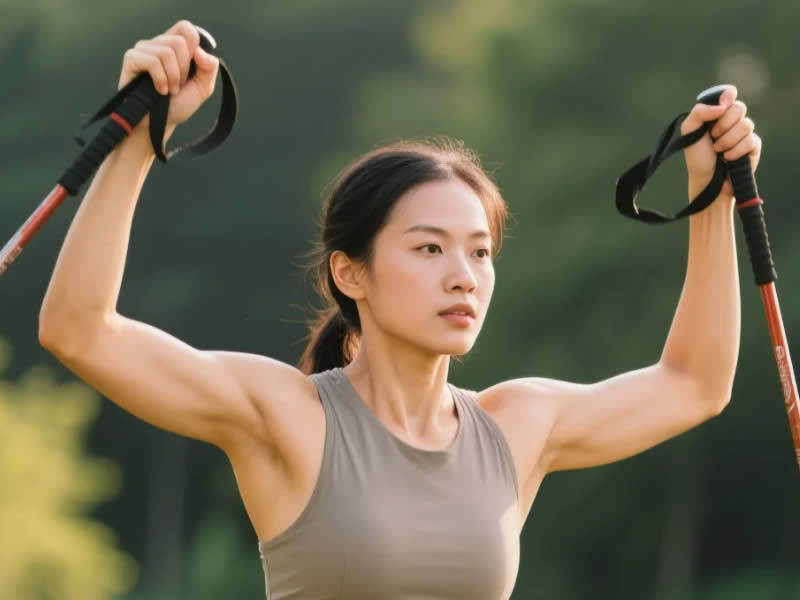
The biomechanics – how poles engage your upper body
When you walk without poles, your upper body mostly plays a passive role – arms swing for balance, but they don't contribute to propulsion. With trekking poles, every plant and push engages a chain of muscles:
- Shoulders (deltoids) – lifting and planting the pole ahead requires shoulder flexion and abduction.
- Triceps – the primary pushing muscle when you drive the pole backwards into the ground.
- Chest (pectorals) – assists in the forward‑downward push, especially on steep terrain.
- Back (latissimus dorsi and trapezius) – stabilises your shoulder girdle and transfers force from your core to the poles.
- Core (abdominals and obliques) – maintains posture and rotation stability as you alternate poles with your stride.
- Forearms and grip – constantly engaged to hold, guide, and control the poles.
The key to muscle engagement is active pushing – not just resting your hands on the poles. Each plant should involve a deliberate backward thrust, using your arms to propel your body forward. This is where the workout happens.
The science – what studies show
Research on the physiological effects of trekking poles is clear:
- Increased energy expenditure – studies (e.g., a 2015 paper in the Journal of Sports Medicine and Physical Fitness) show that walking with poles increases caloric burn by 20‑30% compared to walking without poles at the same speed. A significant portion of this extra energy comes from upper‑body muscle recruitment.
- Muscle activation – electromyography (EMG) studies have recorded elevated activity in the triceps, deltoids, and latissimus dorsi when using poles, especially on ascents.
- Sustained endurance – long‑distance walkers report less fatigue in their legs and a more even distribution of effort across their bodies, partly because their upper body muscles are working consistently.
For example, a 160‑lb (73 kg) walker burns roughly 300‑350 calories per hour on a moderate walk without poles. With poles and an active pushing technique, that can rise to 380‑420 calories per hour – with a significant portion attributable to arm and back work.
The upper‑body workout profile – what you're actually building
Using trekking poles regularly provides a form of low‑intensity, high‑endurance upper‑body training. It won't give you bulging biceps, but it will:
- Improve muscular endurance – your arms, shoulders, and back become more fatigue‑resistant, which translates to better posture and less slouching on long walks.
- Strengthen stabilising muscles – the small rotator cuff muscles and scapular stabilisers are constantly engaged, improving shoulder health and reducing injury risk.
- Enhance core stability – the alternating arm‑leg coordination requires core engagement to maintain balance, especially on uneven terrain.
- Increase grip strength – a functional strength that carries over to everyday activities, from carrying shopping to opening jars.
For older walkers or those with sedentary lifestyles, this upper‑body engagement is a valuable addition to cardiovascular fitness.
How to maximise the upper‑body workout – technique matters
You don't automatically get a workout just by holding poles. To engage your upper body effectively:
1. Use the straps properly
Thread your hand up through the strap from below, grip the handle, and let the strap sit across the base of your fingers. Push down and back – the strap should bear the weight, not your grip. This allows you to transfer force from your back and shoulders directly into the pole.
2. Plant with purpose
Don't just tap the ground – plant firmly and push. On flats, think of the pole as a miniature oar – you're pulling yourself forward with each stroke. On uphills, push down and back as if you're climbing a ladder with your arms.
3. Maintain an upright posture
Slouching reduces core and back engagement. Stand tall, with shoulders back and chest open. Your arms should swing from the shoulder, not just the elbow, to recruit larger muscles.
4. Lengthen your stride (on flats)
A longer stride with a more pronounced backward push increases the range of motion and muscle activation. Don't shuffle – stride purposefully.
5. Use resistance
If you want a harder upper‑body workout, try walking without the poles' spring effect – rigid poles (or locking out anti‑shock) require more muscular effort than spring‑assisted ones.
6. Vary the rhythm
Alternate between a brisk, short‑stride cadence and a slower, longer‑push pace. Different rhythms recruit different muscle fibres and prevent adaptation.
How it compares to other upper‑body exercises
| Activity | Upper‑body engagement | Calories/hour (approx) |
|---|---|---|
| Walking without poles | Minimal | ~300 |
| Walking with poles (active) | Moderate – endurance | ~380‑420 |
| Nordic walking | High – full upper‑body power | ~450‑500 |
| Light gym weight training | High – strength building | ~300‑400 |
| Swimming (moderate) | High – full body | ~400‑600 |
Trekking pole walking sits between regular walking and Nordic walking in intensity. It's not a strength‑building workout, but it's excellent for sustained muscular endurance – exactly what you need for long‑distance hiking.
Does it replace gym work?
No. Trekking poles provide a form of low‑intensity, high‑repetition endurance training. They won't build significant muscle mass or increase your one‑rep max. But they are a valuable supplement – especially for walkers who want to maintain upper‑body fitness without dedicated gym sessions. They're particularly useful for:
- Warm‑up and cool‑down – gentle arm swings with poles prepare your shoulders and back for more intense activity.
- Maintenance on active rest days – a long walk with poles provides a full‑body, low‑impact stimulus.
- Cross‑training for runners – adding poles to a hill walk engages upper‑body muscles that running neglects.
Common mistakes that reduce the workout
- Using a death grip – tight grip fatigues forearms but reduces power transfer to larger muscles. Relax your fingers; let the strap do the work.
- Planting too close to your body – reduces the forward‑backward travel of the arm, cutting the range of motion. Plant ahead and push through.
- Keeping arms too straight – a locked elbow prevents triceps engagement; keep a slight bend to maintain active pushing.
- Slouching – compromises back engagement and reduces core stabilisation.
- Using the poles as a crutch – leaning on them without pushing turns poles into passive supports, not active fitness tools.
Final verdict – yes, but it's a different kind of workout
Trekking poles do help with an upper‑body workout – they engage your arms, shoulders, back, and core, increase calorie burn, and build muscular endurance. The workout is low‑impact, sustainable for hours, and a great complement to your regular fitness routine. However, it's not a strength‑building or hypertrophy‑inducing activity; it's a form of active, sustained muscular engagement that improves functional strength and endurance.
To get the most out of it, focus on technique: push through the straps, keep good posture, and plant with purpose. With a few adjustments, your next walk with poles can be as good for your upper body as it is for your legs and lungs.




