




How to repair a bent aluminium trekking pole?
You're halfway up a ridge, and you take a stumble—your weight comes down awkwardly on the pole, and you see a noticeable bend in the shaft. Your heart sinks. But all is not lost. A bent aluminium trekking pole is often repairable, at least temporarily. Unlike carbon fibre, which shatters catastrophically, aluminium has a degree of malleability. It can be bent back into shape. However, this repair comes with a crucial caveat: a straightened pole is never as strong as it was originally. This guide covers how to assess the damage, the step-by-step repair process for both field and home repairs, and—most importantly—when to retire a pole for good.
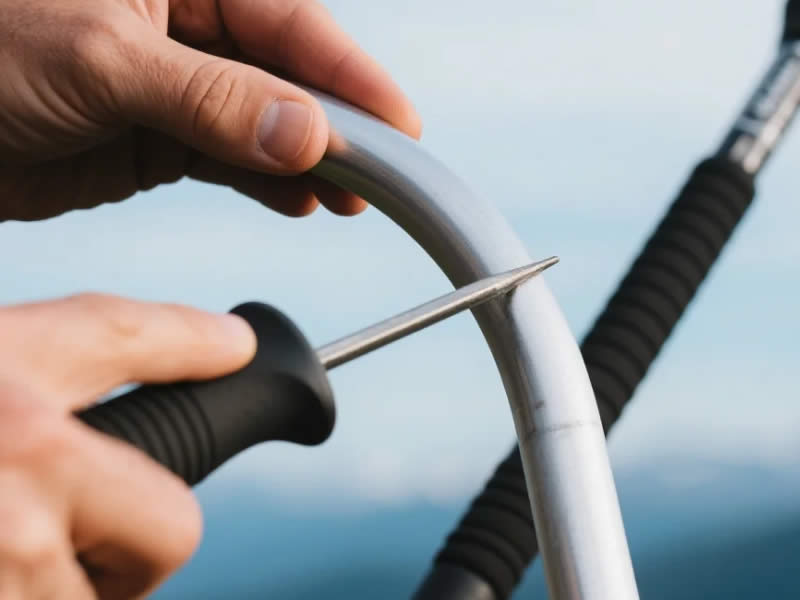
Assessing the Damage: Is It Repairable?
Before you even try to bend it back, you need to evaluate the bend. Not every bent pole can be saved.
Slight Bend (Repairable)
- A gentle curve or a bend of less than 10-15 degrees.
- The metal shows no creases, sharp kinks, or cracks.
- The pole still extends and collapses (though with resistance).
Severe Bend (Replace)
- A sharp 45-degree or more bend, or a distinct "kink" (a crease in the metal).
- There are cracks or splinters in the aluminium.
- The lower section is bent so badly that it won't slide through the upper section.
Key Safety Warning: If you can feel a sharp crease with your fingernail, the metal has been fatigued and stretched. Bending it back will make it dangerously weak. Such a pole is not safe for walking—retire it immediately.
The Field Fix – Getting You Off the Hill
This is a temporary repair designed to get you down from the mountain. It will not restore the pole to its original strength.
What You Need:
- Your hands.
- A solid, flat surface like a large rock or a wooden fence post.
- A tree root or a gap in a rock can be used to brace the pole.
How to Do It:
- Remove the Lower Section: If the bend is on the lower section (the most common place), try to separate it from the upper section. This makes the repair easier and protects the locking mechanism.
- Bend It Back: Place the bent section on the flat rock or brace it against a solid object. Apply even, gentle pressure with your hands to bend it back towards its original straight line.Alternative: You can often bend a slight curve back by pressing the pole against the inside of your bent knee and pulling the ends. This is a classic "over the knee" field repair.
- Avoid Sharp Bends: Do not bend it sharply or quickly. You want to slowly encourage the metal to return to shape. Applying sudden force can cause a kink or a crack.
- Check the Lock: Reattach the section and test the locking mechanism. If the pole can be extended, locked, and holds your weight, it's good enough to get you down.
Crucial Tip: This is a temporary fix. Treat the pole with extreme caution on descents. Lean less weight on it than you normally would, and consider using it as a secondary support.
The Home Workshop Repair – A More Thorough Fix
If you want to attempt a more permanent repair, doing it at home with proper tools gives you better control.
What You Need:
- A vice or a sturdy workbench.
- Soft cloths or a piece of leather to protect the pole's anodised finish.
- Wooden blocks (optional, but helpful for even pressure).
- A rubber mallet (optional).
How to Do It:
- Remove the Section: Take the bent section off the pole.
- Protect the Shaft: Wrap the section in a cloth to prevent scratching.
- Clamp It: Place the bent section in the vice, clamping it on the bend itself. Don't clamp it tightly—you want to gently squeeze it straight.
- Apply Gentle Pressure: Close the vice slowly, applying pressure to the high point of the bend. You want to slowly force the metal back into a straight line. If you don't have a vice, you can place the pole on a flat wooden block and gently tap the bend with a rubber mallet.
- Check for Straightness: Roll the section on a flat surface. If it rolls smoothly, you've straightened it.
The "Insert and Straighten" Method
Another effective method uses the upper section of the pole itself:
- Collapse the pole so the bent lower section is inside the upper section.
- Use the upper section as a straightening "splint."
- Gently bend the pole straight, using the upper section's straightness as a guide.
- This method is surprisingly effective for mild bends.
The "Boiling Water" Trick (For Stubborn Locks)
Sometimes, a bend near the lock can cause the lock to slip or jam. If the lock is stuck or the sections won't separate:
- Submerge the joint in boiling water for 30-60 seconds. This softens the plastic wedge or expands the aluminium slightly, freeing the lock.
How to Test a Repaired Pole
Before you trust a straightened pole on a serious walk, you must test it:
- The Weight Test: Extend the pole to your normal length. Plant it on a firm floor and lean your full weight onto it. If it holds, good. If it flexes excessively or bends again, it's not safe.
- The Lock Test: Lock the pole and try to twist the sections. If there's any play or slipping, the lock is compromised.
When to Give Up – The Cost of Safety
As much as we love our gear, safety must come first. Retire a pole if:
- There's a sharp kink or crease – the metal is stretched and will break with a sudden load.
- The lock doesn't hold – a slipping pole on a descent is a hazard.
- It's a cheap pole – the cost of a replacement is less than the risk of a broken pole.
Don't try to repair carbon fibre poles – they don't bend; they snap. A broken carbon pole is scrap.
What to Do with an Unusable Pole
A bent pole that can't be repaired can still have a second life:
- Tent Pole: Use it as an extra tent pole for a tarp or porch.
- Plant Support: Use it in the garden for climbing plants.
- Spare Parts: Salvage the grips, baskets, and tip.
Safety Warning – The Bottom Line
A straightened aluminium pole is weakened. It may be fine for gentle, flat walking, but it is no longer trustworthy for steep descents or heavy loads. If you value your safety, especially on challenging terrain, replace a badly bent pole.
Final Verdict
| Type of Bend | Action |
|---|---|
| Slight curve (<15°) | Straighten it, test it, use it for gentle terrain |
| Sharp kink or crease | Retire it – it's a safety hazard |
| Bend near the lock | Straighten with care, test the lock thoroughly |
Yes, you can repair a bent aluminium trekking pole, and a field fix can save your walk. But always treat it with caution. If in doubt, a new section is a small price to pay for peace of mind on the hills. (Word count: ~1,080)
How to repair a bent aluminium trekking pole?
You're halfway up a ridge, and you take a stumble—your weight comes down awkwardly on the pole, and you see a noticeable bend in the shaft. Your heart sinks. But all is not lost. A bent aluminium trekking pole is often repairable, at least temporarily. Unlike carbon fibre, which shatters catastrophically, aluminium has a degree of malleability. It can be bent back into shape. However, this repair comes with a crucial caveat: a straightened pole is never as strong as it was originally. This guide covers how to assess the damage, the step-by-step repair process for both field and home repairs, and—most importantly—when to retire a pole for good.
Assessing the Damage: Is It Repairable?
Before you even try to bend it back, you need to evaluate the bend. Not every bent pole can be saved.
Slight Bend (Repairable)
- A gentle curve or a bend of less than 10-15 degrees.
- The metal shows no creases, sharp kinks, or cracks.
- The pole still extends and collapses (though with resistance).
Severe Bend (Replace)
- A sharp 45-degree or more bend, or a distinct "kink" (a crease in the metal).
- There are cracks or splinters in the aluminium.
- The lower section is bent so badly that it won't slide through the upper section.
Key Safety Warning: If you can feel a sharp crease with your fingernail, the metal has been fatigued and stretched. Bending it back will make it dangerously weak. Such a pole is not safe for walking—retire it immediately.
The Field Fix – Getting You Off the Hill
This is a temporary repair designed to get you down from the mountain. It will not restore the pole to its original strength.
What You Need:
- Your hands.
- A solid, flat surface like a large rock or a wooden fence post.
- A tree root or a gap in a rock can be used to brace the pole.
How to Do It:
- Remove the Lower Section: If the bend is on the lower section (the most common place), try to separate it from the upper section. This makes the repair easier and protects the locking mechanism.
- Bend It Back: Place the bent section on the flat rock or brace it against a solid object. Apply even, gentle pressure with your hands to bend it back towards its original straight line.Alternative: You can often bend a slight curve back by pressing the pole against the inside of your bent knee and pulling the ends. This is a classic "over the knee" field repair.
- Avoid Sharp Bends: Do not bend it sharply or quickly. You want to slowly encourage the metal to return to shape. Applying sudden force can cause a kink or a crack.
- Check the Lock: Reattach the section and test the locking mechanism. If the pole can be extended, locked, and holds your weight, it's good enough to get you down.
Crucial Tip: This is a temporary fix. Treat the pole with extreme caution on descents. Lean less weight on it than you normally would, and consider using it as a secondary support.
The Home Workshop Repair – A More Thorough Fix
If you want to attempt a more permanent repair, doing it at home with proper tools gives you better control.
What You Need:
- A vice or a sturdy workbench.
- Soft cloths or a piece of leather to protect the pole's anodised finish.
- Wooden blocks (optional, but helpful for even pressure).
- A rubber mallet (optional).
How to Do It:
- Remove the Section: Take the bent section off the pole.
- Protect the Shaft: Wrap the section in a cloth to prevent scratching.
- Clamp It: Place the bent section in the vice, clamping it on the bend itself. Don't clamp it tightly—you want to gently squeeze it straight.
- Apply Gentle Pressure: Close the vice slowly, applying pressure to the high point of the bend. You want to slowly force the metal back into a straight line. If you don't have a vice, you can place the pole on a flat wooden block and gently tap the bend with a rubber mallet.
- Check for Straightness: Roll the section on a flat surface. If it rolls smoothly, you've straightened it.
The "Insert and Straighten" Method
Another effective method uses the upper section of the pole itself:
- Collapse the pole so the bent lower section is inside the upper section.
- Use the upper section as a straightening "splint."
- Gently bend the pole straight, using the upper section's straightness as a guide.
- This method is surprisingly effective for mild bends.
The "Boiling Water" Trick (For Stubborn Locks)
Sometimes, a bend near the lock can cause the lock to slip or jam. If the lock is stuck or the sections won't separate:
- Submerge the joint in boiling water for 30-60 seconds. This softens the plastic wedge or expands the aluminium slightly, freeing the lock.
How to Test a Repaired Pole
Before you trust a straightened pole on a serious walk, you must test it:
- The Weight Test: Extend the pole to your normal length. Plant it on a firm floor and lean your full weight onto it. If it holds, good. If it flexes excessively or bends again, it's not safe.
- The Lock Test: Lock the pole and try to twist the sections. If there's any play or slipping, the lock is compromised.
When to Give Up – The Cost of Safety
As much as we love our gear, safety must come first. Retire a pole if:
- There's a sharp kink or crease – the metal is stretched and will break with a sudden load.
- The lock doesn't hold – a slipping pole on a descent is a hazard.
- It's a cheap pole – the cost of a replacement is less than the risk of a broken pole.
Don't try to repair carbon fibre poles – they don't bend; they snap. A broken carbon pole is scrap.
What to Do with an Unusable Pole
A bent pole that can't be repaired can still have a second life:
- Tent Pole: Use it as an extra tent pole for a tarp or porch.
- Plant Support: Use it in the garden for climbing plants.
- Spare Parts: Salvage the grips, baskets, and tip.
Safety Warning – The Bottom Line
A straightened aluminium pole is weakened. It may be fine for gentle, flat walking, but it is no longer trustworthy for steep descents or heavy loads. If you value your safety, especially on challenging terrain, replace a badly bent pole.
Final Verdict
| Type of Bend | Action |
|---|---|
| Slight curve (<15°) | Straighten it, test it, use it for gentle terrain |
| Sharp kink or crease | Retire it – it's a safety hazard |
| Bend near the lock | Straighten with care, test the lock thoroughly |
Yes, you can repair a bent aluminium trekking pole, and a field fix can save your walk. But always treat it with caution. If in doubt, a new section is a small price to pay for peace of mind on the hillS




