




How to Use Walking Poles for Downhill Walking? Mastering the Descent
For many hikers, the descent is the most punishing part of the journey. Knees ache, quivers burn, and the constant braking force required to control your speed takes a heavy toll. Yet this is precisely where walking poles offer their greatest benefit. Properly used on downhills, poles can reduce knee impact by up to 25%, provide critical stability on loose terrain, and transform a painful descent into a controlled, confident walk. This guide provides a comprehensive methodology for using poles on downhill terrain, ensuring you reach the bottom with your joints—and your spirits—intact.
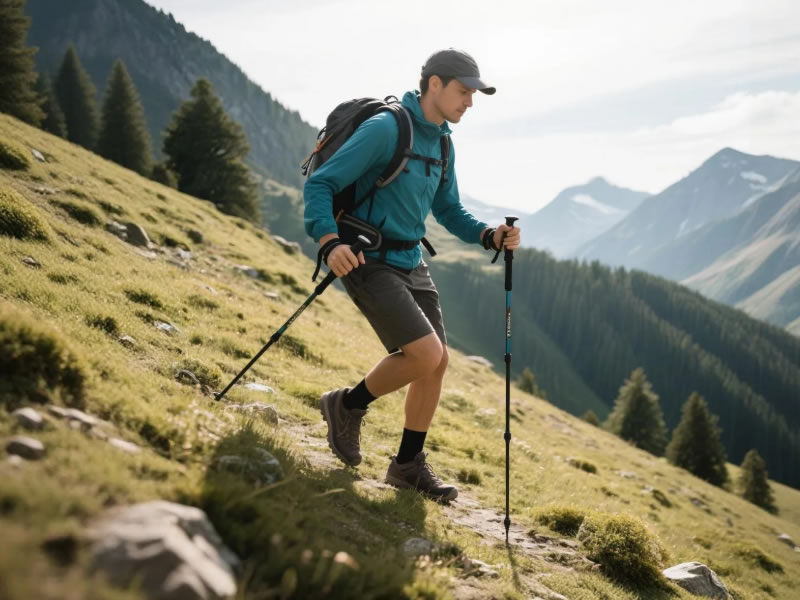
Recommended trekking pole purchase link: https://s.click.aliexpress.com/e/_c4M7OWaN
The Core Principle: Poles as Brakes and Shock Absorbers
On downhills, your poles shift function from propulsion to braking and impact absorption. The goal is to plant the pole ahead of your body and transfer a portion of your weight onto it, using your arms and upper body to control your descent and reduce the load on your knees.
Step 1: Adjust Pole Length for Downhill
Lengthen your poles by 5–15 cm (2–6 inches) from your flat‑terrain baseline.
| Adjustment | Why |
|---|---|
| Lengthen | Allows you to plant the tip ahead and downhill of your body, creating a true braking action. A longer pole also provides better leverage for weight transfer. |
If your poles are too short:
- You will plant beside or behind your body, providing minimal braking.
- You will have to bend forward excessively, compromising balance.
- You cannot effectively transfer weight onto the pole.
The test: On a moderate descent, with poles lengthened, you should be able to plant the tip comfortably ahead of your leading foot while maintaining an upright torso. Your elbow should be slightly bent at the point of planting.
Step 2: Master the Downhill Plant
The Standard Downhill Technique
- Plant the tip firmly ahead and downhill of your leading foot. The exact distance depends on the steepness—steeper slopes require planting further ahead.
- Engage the strap correctly. Your hand should be inserted upward from below, with the strap across the back of your wrist. This allows you to push down through the strap rather than gripping the handle.
- Transfer weight onto the pole as you step down. You should feel your arm and shoulder supporting a portion of your body weight.
- Maintain the opposite arm/leg rhythm: Right pole plants as left foot steps forward; left pole plants as right foot steps forward. This contralateral coordination is essential for balance.
Why it works: By planting ahead and transferring weight, you create a temporary third point of contact that acts as a brake. The impact that would have been absorbed entirely by your knee is now partially dissipated through your arm and the pole.
Step 3: Maintain Upright Posture
Proper downhill posture is critical:
- Do not lean back. This common defensive posture actually reduces stability and increases strain on your knees.
- Keep your torso upright or with a very slight forward lean, aligned over your hips.
- Look ahead, not down at your feet. Your poles are probing the terrain; trust them.
If you find yourself leaning back, your poles may be too short. Lengthen further.
Step 4: The Double‑Plant for Steep or Loose Terrain
On very steep, slippery, or unstable descents, abandon the alternating rhythm and use the double‑plant technique:
- Plant both poles firmly downhill at the same time, creating a stable "tripod" with your feet.
- Take one or two steps down to meet the poles.
- Re‑plant both poles further downhill and repeat.
This technique guarantees three points of contact at all times and is the safest way to descend extremely steep or treacherous terrain. It is also useful when you need to pause and assess the route ahead.
Step 5: Braking and Speed Control
- For gentle braking: Plant normally and allow the pole to support some weight.
- For increased braking: Plant more firmly and lean more weight onto the pole.
- For maximum control on very steep slopes: Use the double‑plant and descend slowly, deliberately.
Do not attempt to "ski" with your poles—planting and sliding. This reduces control and can cause the tip to catch unexpectedly.
Common Downhill Mistakes
| Mistake | Consequence | Correction |
|---|---|---|
| Poles too short | Ineffective braking; increased knee strain. | Lengthen 5–15 cm before descending. |
| Planting beside or behind body | No braking action; poles merely tag along. | Plant firmly ahead of leading foot. |
| Leaning back | Reduces stability; increases knee load. | Maintain upright posture, slight forward lean. |
| Death grip on handles | Rapid hand fatigue; poor weight transfer. | Use straps correctly; relax grip. |
| Ignoring the straps | All weight borne by hand muscles. | Push through strap, not grip. |
| Stiff arms | Disrupts shock absorption. | Allow natural elbow flexion. |
| Rushing / skidding | Loss of control; increased fall risk. | Descend deliberately; use double‑plant if needed. |
Gear Considerations for Downhill
| Feature | Why It Matters for Downhill |
|---|---|
| Adequate length range | Must allow 5–15 cm extension beyond baseline. |
| Secure locking mechanisms | Poles must not slip under heavy braking load. External lever locks preferred. |
| Comfortable, padded straps | Essential for effective weight transfer without hand fatigue. |
| Carbide tips | Provide reliable traction on rock, gravel, and hardpack. |
| Shock‑absorbing poles (optional) | Internal springs further reduce impact on wrists and elbows. |
Downhill Poles and Knee Pain
For individuals with knee concerns, the downhill segment is where poles provide the greatest benefit. Research indicates that proper pole use can reduce compressive knee forces by 20–25% on descents. To maximize this:
- Lengthen poles at the top of every descent. Do not wait until you are halfway down.
- Transfer as much weight as possible through the straps.
- Use the double‑plant on the steepest sections to maximize stability and offloading.
Downhill Poles and Heavy Packs
When descending with a heavy backpack, the benefits—and the risks—are magnified:
- Always double‑check lock security before committing weight.
- Use the double‑plant more frequently to manage the shifted center of gravity.
- Descend slowly and deliberately. Your margins for error are reduced.
Summary: Downhill Pole Technique at a Glance
| Element | Correct Technique |
|---|---|
| Length | Lengthen 5–15 cm from baseline. |
| Plant position | Firmly ahead and downhill of leading foot. |
| Strap use | Hand up from below; push through strap. |
| Rhythm | Opposite arm/leg (right pole/left foot). |
| Weight transfer | Lean onto pole; let it support you. |
| Posture | Upright, slight forward lean, looking ahead. |
| Very steep / loose | Double‑plant: both poles ahead, then step. |
Conclusion: The Descent Becomes a Joy
Downhill walking does not have to be a knee‑jarring ordeal. With proper pole technique, it becomes a controlled, confident, and even enjoyable part of the journey. The key adjustments are simple:
- Lengthen your poles.
- Plant ahead.
- Transfer weight through the straps.
- Use the double‑plant when needed.
Practice these elements on your next descent. You will feel the difference immediately—in your knees, your balance, and your confidence. The bottom of the hill will no longer be a relief to reach, but just another point on a journey you control completely.
Your knees will thank you. Your whole body will, too.




