




Trekking Pole Custom-molded grips – any company offers this?
The idea of a trekking pole grip custom-molded to the exact contours of your hand is undeniably appealing. Imagine a handle that fits like a glove, eliminating pressure points, optimizing force transfer, and feeling like an extension of your body. For hikers who spend hundreds of hours on the trail, the pursuit of perfect ergonomics is natural. But does such a product actually exist in the mainstream market? This deep dive explores the reality of custom-molded trekking pole grips, the closest alternatives available, and why true custom molding remains a niche concept in the outdoor industry.
Recommended trekking pole purchase link: https://s.click.aliexpress.com/e/_c4M7OWaN
The Straight Answer: Not in Mainstream Trekking Poles
No major trekking pole manufacturer—Black Diamond, Leki, Komperdell, REI, Gossamer Gear, or others—offers custom-molded grips as a standard service. Unlike custom footbeds for hiking boots or heat-moldable ski boots, trekking pole grips have not yet entered the era of per-user personalization.
Why not? Several factors explain this gap:
- Cost: Custom molding requires individual manufacturing, which is prohibitively expensive for a product category where even premium poles sell for $150–$200.
- Volume: The trekking pole market is large but not large enough to support the infrastructure for custom grips at scale.
- Durability concerns: Molding materials (thermoplastics, heat-activated foams) may not withstand the abrasion, UV exposure, and weather conditions that trekking poles endure.
- Warranty complexity: Custom products complicate returns, replacements, and warranty claims.
The Best Alternative: Cork’s Natural Molding
While not “custom” in the manufacturing sense, cork grips offer the closest thing to a personalized fit through natural use.
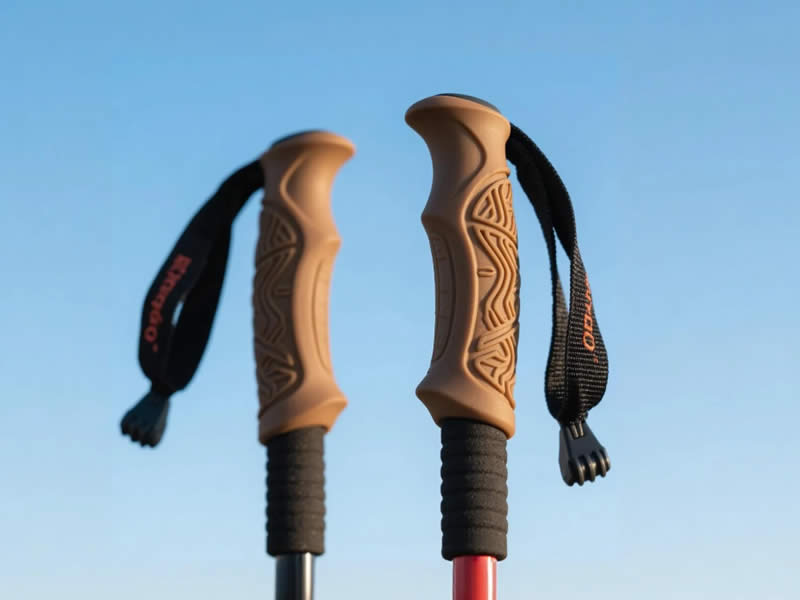
How it works: High-quality cork grips are made from compressed granulated cork. Over hours and miles of use, the cork compresses under the pressure points of your hand—your palm heel, thumb base, and each finger’s contact area. The material slowly conforms to your unique grip shape.
The result: After 20–50 hours of use, a cork grip effectively becomes custom-molded to your hand. The fit improves with age, unlike foam or rubber grips that degrade uniformly.
Advantages: Natural molding, breathable, moisture-wicking, sustainable.
Limitations: Takes time to break in; not adjustable; cannot be remolded for a different user.
For most hikers, cork grips provide a level of personalized comfort that rivals custom manufacturing—without the premium price tag.
Medical and Rehabilitative Poles: The Exception
The one category where custom-molded grips occasionally appear is medical or rehabilitative walking poles. Companies specializing in mobility aids for individuals with arthritis, stroke recovery, or hand deformities sometimes offer custom-molded handles. These are typically:
- Thermoplastic molds: Heated and shaped to the patient’s hand in a clinical setting
- Silicone or foam casts: Created from a hand impression
- 3D-printed custom designs: Using hand scans to generate personalized grip geometry
These products are not marketed to recreational hikers. They are expensive (often $300–$600 per pair), require professional fitting, and are designed for stability rather than dynamic trekking.
What About Heat-Moldable Foam?
A common question is whether heat-moldable foam—popular in ski boots and some backpack hip belts—exists for trekking pole grips. Currently, no major pole manufacturer offers this technology. The challenges include:
- Heat application: Molding requires an oven or heat gun, which is impractical at retail
- Recovery: Molded foam may return to shape over time or deform in hot car trunks
- Durability: Repeated heating cycles degrade foam integrity
Some niche makers have experimented, but a commercial product has not emerged.
3D Printing: The Future Possibility
3D printing technology offers a potential path to custom grips. A hand scan could generate a 3D model, printed in durable materials (nylon, carbon-reinforced polymers), and fitted to standard pole shafts. Several small-scale makers offer this as a bespoke service, but:
- Cost: Typically $150–$300 per pair for the grips alone
- Availability: Requires scanning equipment; not widely available
- Lead time: Weeks, not days
As 3D printing becomes more accessible, custom grips may trickle into the mainstream. For now, they remain a luxury for enthusiasts willing to invest significant time and money.
The Closest You Can Buy Today
If you want the most personalized fit available off the shelf:
- Choose cork grips. Leki, Black Diamond, and Komperdell all offer premium cork models.
- Select anatomic (ergonomic) shapes. Left/right-specific, forward-angled grips reduce the need for custom molding by matching natural hand anatomy.
- Invest time in break-in. Use your new poles for several long hikes before judging comfort—cork needs time to conform.
- Consider aftermarket wraps. Silicone or foam grip wraps can add thickness or contour to existing grips, though they may compromise control.
The Verdict
No mainstream trekking pole company offers true custom-molded grips. The economics, manufacturing complexity, and market demand have not aligned to make such a product viable. However, cork grips provide a natural, user-driven alternative that effectively molds to your hand over time—delivering many of the benefits of custom manufacturing without the cost or complexity.
For hikers seeking the ultimate in personalized comfort, the combination of high-quality cork grips, anatomic shaping, and patient break-in time yields results that satisfy all but the most demanding ergonomic needs.
Perfect fit doesn’t require custom manufacturing—sometimes it just requires miles.




