




Trekking poles Self-sharpening tips – marketing gimmick or real?
In the world of trekking pole accessories, few claims sound as futuristic—and as suspiciously convenient—as “self-sharpening tips.” The idea that a metal tip could somehow keep itself sharp through use, without any action from the user, seems almost magical. Is this genuine materials science, or is it clever marketing wrapped around a standard carbide tip? This deep dive examines the technology behind self-sharpening tips, separates fact from hype, and helps you determine whether this feature deserves a place in your gear selection criteria.
Recommended trekking pole purchase link: https://s.click.aliexpress.com/e/_c4M7OWaN
What “Self-Sharpening” Actually Means
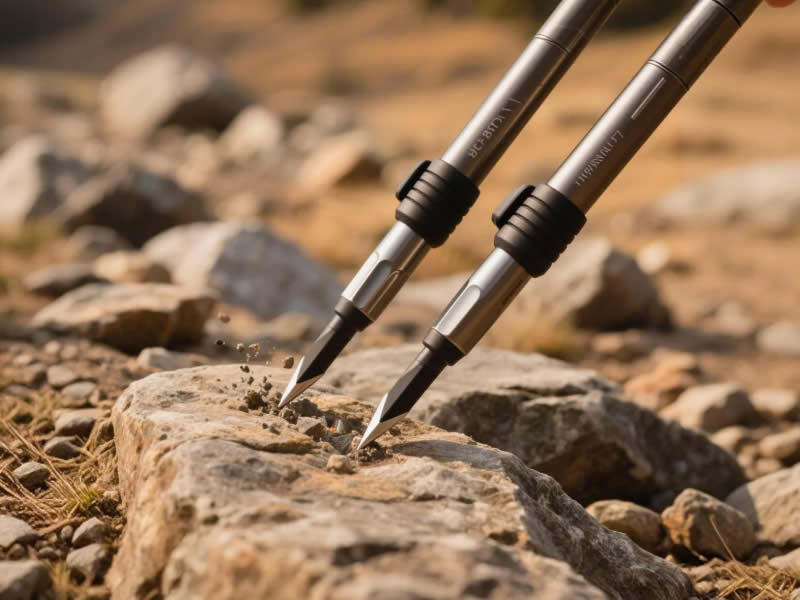
The term “self-sharpening” in trekking pole tips refers to a specific metallurgical property of certain tungsten carbide formulations. Standard carbide tips are made from tungsten carbide particles bound together with a cobalt matrix. Over time, as the tip wears against rock and abrasive surfaces, the softer cobalt binder wears away faster than the harder tungsten carbide particles. This exposes fresh, sharp carbide edges—effectively maintaining a rougher, more aggressive surface texture than a uniformly worn tip.
Key distinction: This is not “sharpening” in the sense of a knife blade becoming sharper. It is maintenance of micro-texture. The tip does not become sharper than it was when new; rather, it resists becoming smooth and rounded as quickly as standard carbide tips.
The Science Behind It
Material composition:
- Standard carbide tips: Tungsten carbide particles in a cobalt binder, often with a uniform particle size
- “Self-sharpening” tips: Engineered with a specific cobalt-to-carbide ratio and particle size distribution that optimizes differential wear
Wear mechanism:
As the tip contacts rock and abrasive surfaces:
- The cobalt binder wears preferentially (faster)
- Tungsten carbide particles (harder) remain proud of the surface
- The resulting micro-topography creates a “sharp” or “toothy” surface with enhanced grip
- This process continues throughout the tip’s life, maintaining traction longer
This is the same principle behind self-sharpening industrial cutting tools, mining drill bits, and some high-end knife steels (such as those with vanadium carbide content).
Real-World Performance
Does it work?
Yes—but the effect is subtle rather than dramatic. Users of high-quality carbide tips with optimized formulations report:
- Consistent traction longer: The tip maintains bite on rock and hard surfaces for a greater percentage of its lifespan compared to standard carbide.
- Less noticeable dulling: Instead of gradually becoming rounded and slippery, the tip retains a textured surface until it is significantly worn.
- No “magic”: The tip does not become sharper than new, nor does it last indefinitely.
Quantifiable difference: Independent testing (limited, as this is a niche feature) suggests self-sharpening formulations can extend effective tip life by 20–40% compared to standard carbide under similar abrasive conditions.
Marketing vs. Reality
| Claim | Reality |
|---|---|
| “Self-sharpening tip” | Technically accurate—differential wear maintains micro-texture |
| “Always sharp” | Overstates; wear still occurs, just slower |
| “Never needs replacement” | False; all tips eventually wear |
| “Revolutionary technology” | Overstates; metallurgical principle is well-established |
The concept is real, but the marketing often exaggerates the effect. A self-sharpening tip is not a maintenance-free solution; it is a better-engineered tip that delivers longer consistent performance.
Who Should Care?
Self-sharpening tips are most valuable for:
- High-mileage hikers: Those who wear out standard tips in a season will appreciate extended lifespan.
- Rocky terrain specialists: On abrasive granite, sandstone, or volcanic rock, differential wear has the most noticeable effect.
- Hikers who value consistent performance: If you want predictable traction throughout the tip’s life rather than gradual decline.
They matter less for:
- Casual hikers: If you replace poles every few years or hike primarily on soft surfaces, the difference is negligible.
- Those who prioritize replaceable tips: A standard interchangeable tip system allows easy replacement regardless of wear characteristics.
The Verdict
Self-sharpening tips are a real materials science feature, not merely a marketing gimmick. The principle of differential wear between binder and carbide particles is legitimate, and high-quality tips with optimized formulations do maintain traction longer than standard carbide tips.
However, the term “self-sharpening” is often oversold. The effect is subtle, not transformative. For most hikers, the choice between standard and self-sharpening tips matters far less than:
- Whether the tips are replaceable (interchangeable systems)
- The overall build quality of the poles
- Proper maintenance (cleaning, storage)
If you are choosing between two high-quality poles with all other factors equal, self-sharpening tips are a nice bonus—especially for rocky terrain or high-mileage use. But do not let marketing claims distract from the fundamentals: replaceable tips, reliable locks, and ergonomic grips remain the features that truly define a pole’s long-term value.
Let the science inform your choice, but let the fundamentals guide it.




