




Smart Trekking Poles with haptic feedback for navigation?
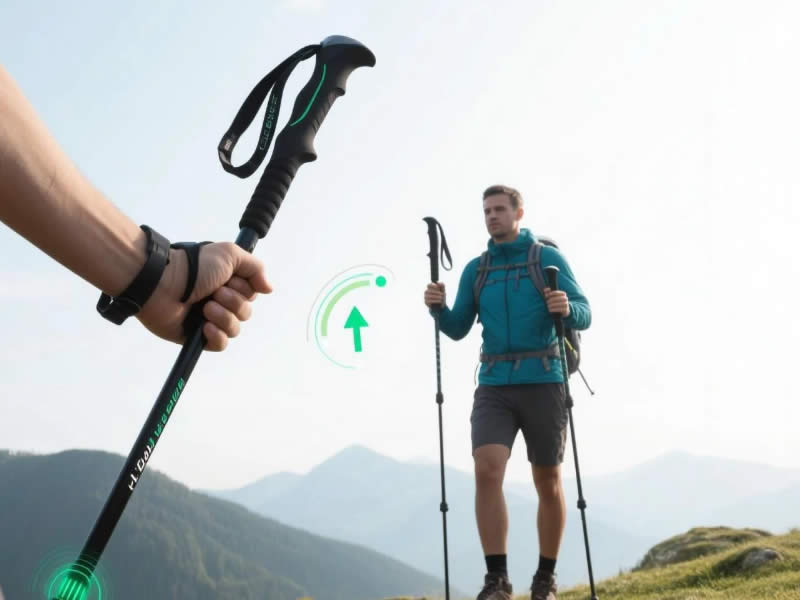
Imagine hiking in a dense forest, fog rolling in, your phone’s GPS showing the trail, but you don’t want to keep looking down at a screen. Or perhaps you have low vision and want a safe, intuitive way to explore the backcountry. Now imagine that your trekking poles—already in your hands—could guide you with gentle vibrations: a buzz in the left pole means “turn left,” a buzz in the right means “turn right,” and a double buzz signals “stop” or “wrong direction.” This is the promise of smart trekking poles with haptic feedback for navigation. While still in early stages, this technology is one of the most exciting developments in outdoor gear, blending accessibility, safety, and convenience. This article explores how they work, where the technology stands, and whether they are ready for the trail.
Recommended trekking pole purchase link: https://s.click.aliexpress.com/e/_c4M7OWaN
What Is Haptic Navigation?
Haptic feedback uses vibrations to communicate information through touch. In smartphones, haptics confirm a tap or alert you to a notification. In trekking poles, haptic navigation would replace visual or audio cues with silent, discreet vibrations. The system typically consists of:
- GPS receiver – Built into the pole or paired with your phone.
- Microcontroller – Processes your location relative to a preloaded route.
- Vibration motors – Embedded in the grips, one per pole.
- Bluetooth – For syncing with a smartphone app (if the GPS is on the phone).
- Battery – Rechargeable, housed in the grip or a small pod.
When you approach a turn, the appropriate pole vibrates. For example, if the trail bends left, the left pole buzzes. If you stray off course, both poles might pulse. Some designs also use variable intensity: a soft buzz when you’re near a turn, stronger as you get closer.
Why Haptic Feedback?
Navigation with screens has drawbacks:
- Eyes off the trail – Looking at a phone or watch increases trip and fall risk.
- Screen glare – Sunlight makes displays hard to read.
- Battery drain – Continuous screen use eats power.
- Inaccessible – For visually impaired hikers, screen‑based navigation is challenging.
Haptic feedback solves these problems:
- Eyes‑free – You keep your gaze on the path ahead.
- Works in any light – No screen to read.
- Low power – Vibration motors consume far less energy than a display.
- Accessible – Haptic cues are intuitive for people with visual impairments.
Current State of Technology (2026)
As of this writing, no major brand sells a production model of haptic‑feedback navigation poles. However, the technology exists in prototypes and small‑scale projects:
- University research – Labs at MIT, Carnegie Mellon, and European universities have built working prototypes using off‑the‑shelf components. Studies show that users can follow a route with haptic poles almost as accurately as with a screen, and they report less mental effort.
- Startup attempts – A few crowdfunding campaigns (e.g., “GuidePole,” “VibraTrek”) have raised money, but none have shipped durable, waterproof products. Most failed due to battery life, reliability, or cost.
- DIY community – Hobbyists have built their own haptic poles using Arduino, GPS modules, and vibrating motors. Instructions are available online, but require soldering and programming skills.
- Assistive technology – Some poles designed for blind or low‑vision walkers incorporate haptic feedback, but these are niche medical devices, not mainstream trekking poles.
The closest commercial products are vibrating GPS watches (e.g., Garmin with “turn‑by‑turn” vibrations) and smart insoles (vibrating shoe inserts). But haptic poles remain rare.
Benefits for Different Users
For All Hikers
- Safer navigation – Keep eyes on trail, especially on technical terrain.
- Less distraction – No phone‑checking every few minutes.
- Intuitive – Left/right vibration is natural to interpret.
For Visually Impaired Hikers
- Independence – Trek poles already used for mobility; adding navigation creates a powerful tool.
- No need for audio – Avoids drowning out natural sounds or alerting wildlife.
- Discreet – Vibrations are private, unlike voice guidance.
For Seniors or Those with Cognitive Impairment
- Simple – No complex app to learn.
- Reassuring – Helps stay on track in unfamiliar areas.
Challenges and Limitations
Despite the promise, several hurdles keep haptic poles off store shelves:
- Battery life – GPS and vibration motors draw power. A typical prototype lasts 6–10 hours, insufficient for all‑day treks. Swapping batteries adds weight and complexity.
- Durability – Poles are slammed, submerged, and frozen. Vibration motors and electronics must survive this abuse. Waterproofing (IPX7 or higher) is difficult and expensive.
- Weight – Adding motors, battery, and GPS chip adds 50–100 g per pole. For ultralight hikers, that’s unacceptable.
- Cost – A pair of haptic poles would likely cost $300–500, far above standard poles.
- GPS signal reliability – In deep canyons or dense forests, GPS accuracy drops. Haptic cues could misguide you.
- Learning curve – Users must trust the vibrations; some may find it disorienting at first.
- Route creation – You still need to load a route (GPX file) into the system via an app. That requires a smartphone anyway.
How It Compares to Other Navigation Methods
| Method | Eyes‑free | Battery life | Cost | Accessibility |
|---|---|---|---|---|
| Haptic poles | Yes | 6–10 h (prototype) | High | Excellent |
| GPS watch with vibration | Partial (look at wrist) | 10–30 h | Medium‑high | Good |
| Phone with voice guidance | Yes (audio) | 5–15 h (screen off) | Low (phone) | Moderate (audio) |
| Standard poles + map | No (need to read) | N/A | Low | Poor |
Future Outlook
The technology is advancing rapidly. Low‑power GPS chips (e.g., Sony CXD5605) and efficient linear resonant actuators (vibration motors) are becoming smaller and cheaper. Within 3–5 years, we may see:
- Poles with embedded GPS and haptics – No phone required; battery life 20+ hours.
- Solar‑assisted charging – Tiny panels on the shaft to extend battery.
- Integration with trail apps – AllTrails, Komoot, etc., pushing routes directly to poles.
- Affordable models – Under $200 for a basic pair.
For now, the most practical approach is to pair standard poles with a vibrating GPS watch or phone with voice navigation. You get many of the benefits without the prototype headaches.
Are They Right for You?
If you are a tech enthusiast, a researcher, or a visually impaired hiker seeking independence, haptic poles are worth following. Look for university studies or assistive technology grants that may provide prototypes. For the average hiker, however, the technology is not yet mature. Stick with proven tools and check back in a few years.
Final Thoughts
Smart trekking poles with haptic feedback for navigation represent a brilliant fusion of simple hardware and intelligent software. They promise to make navigation safer, more accessible, and more intuitive. The core concept is sound, and early prototypes prove it works. Yet the outdoor industry moves slowly, and the challenges of battery life, durability, and cost remain significant. For now, haptic poles are a glimpse of the future—exciting, but not ready for your next backpacking trip. Keep an eye on assistive technology markets and university spin‑offs. When they finally arrive, they could change the way we all walk through the wilderness. Until then, enjoy the quiet simplicity of your standard poles and the time‑tested art of map and compass.




