




Which Walking Poles Are Best for Uneven Terrain? The Definitive Guide to Stability, Durability, and Confidence
Uneven terrain—root‑riddled singletrack, loose scree, muddy bogs, and rocky descents—is the ultimate test of walking poles. On smooth pavement, almost any pole will suffice. But when the ground becomes unpredictable, the wrong pole becomes a liability: a bent shaft, a slipping lock, or a tip that skates across rock can turn a confident stride into a stumble. This guide dissects the specific engineering requirements for uneven terrain and identifies the poles that truly excel when the trail demands stability, durability, and instantaneous adaptability.
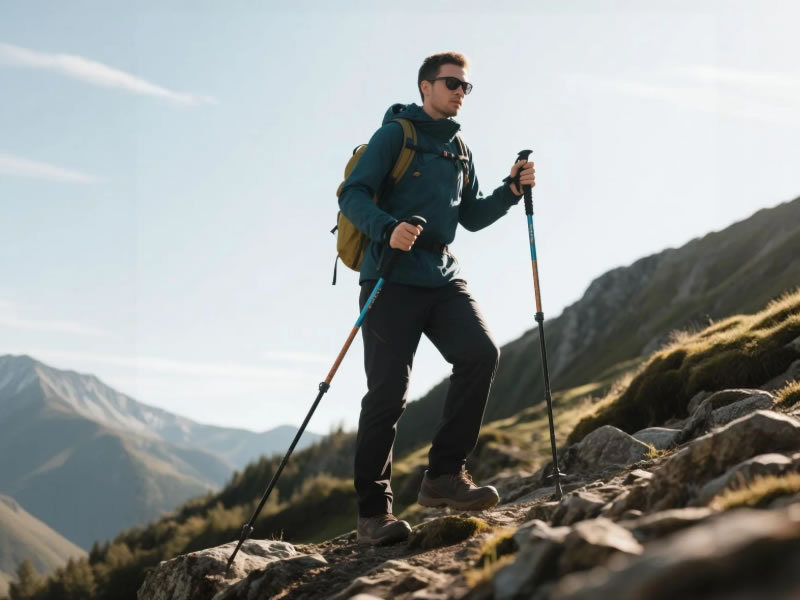
Recommended trekking pole purchase link: https://s.click.aliexpress.com/e/_c4M7OWaN
The Uneven‑Terrain Challenge: What Your Poles Must Overcome
| Hazard | Pole Requirement |
|---|---|
| Lateral impacts (rocks, roots) | Material that bends rather than snaps; robust construction |
| Steep, short‑pitch climbs/descents | Rapid, tool‑free length adjustment |
| Soft ground / mud / snow | Interchangeable large‑diameter baskets |
| Hard rock / ice | Aggressive, long‑lasting carbide tips |
| All‑day grip under variable conditions | Moisture‑wicking, fatigue‑reducing handle material |
| Heavy reliance for balance | Secure, non‑slipping locking mechanism |
1. Material: Why Aluminum Dominates Uneven Ground
The Verdict: 7075‑series aluminum is the superior choice for uneven terrain.
| Material | Strength | Failure Mode | Vibration | Weight | Best For |
|---|---|---|---|---|---|
| 7075 Aluminum | Very high | Bends, rarely snaps | High | Moderate | Rugged, technical terrain |
| 6061 Aluminum | High | Bends | High | Moderate | General uneven trails |
| Carbon Fiber | High (axial) | Brittle; can snap | Low | Low | Smooth trails, weight‑conscious |
Why this matters: On uneven terrain, poles inevitably get jammed between rocks, caught in roots, or used to arrest a stumble. A carbon fiber pole subjected to a sharp lateral blow may snap catastrophically. A quality aluminum pole will bend—often enough to be field‑straightened and finish the hike. For off‑trail travel, alpine scrambling, or any environment where the pole will be abused, aluminum is the only rational choice.
The alloy matters: 7075 aluminum (e.g., Black Diamond’s “Trail” series, LEKI’s “Makalu” series) offers approximately 50% greater yield strength than standard 6061. The slight weight penalty is negligible compared to the gain in durability.
2. Locking Mechanism: External Lever Locks Are Non‑Negotiable
On uneven terrain, you will adjust your pole length constantly—shortening for steep climbs, lengthening for descents, and sometimes altering length mid‑traverse to accommodate side‑hilling.
| Mechanism | Uneven‑Terrain Suitability | Rationale |
|---|---|---|
| External Lever Lock (FlickLock, Speed Lock) | Excellent | Instant operation; visible security; reliable under load; works with gloves |
| Twist Lock | Poor | Difficult to tighten adequately; slips under load; fails when cold/wet |
Key Insight: A lock that slips under load is not merely an inconvenience—it is a safety hazard. On a steep descent, a collapsing pole can cause a fall. External lever locks provide mechanical advantage that can be tightened with a hex key if they loosen over years of use. They are the only acceptable choice for uneven terrain.
3. Grip and Strap: The Human‑Machine Interface
| Feature | Uneven‑Terrain Requirement |
|---|---|
| Grip Material | Cork (molds to hand, wicks sweat, natural grip when wet) or dense foam |
| Grip Shape | Slightly ergonomic but not extreme; must allow quick grip changes |
| Strap | Wide, padded, easily adjustable; must enable weight transfer through the strap |
Why cork? Cork provides superior grip in sweaty or wet conditions without becoming slippery. It also absorbs micro‑vibrations better than hard plastic or thin rubber. For all‑day comfort on janky terrain, cork is unmatched.
Strap mastery: On uneven ground, you will often need to push down through the pole to test footing or stabilize. This force must be transmitted through the strap, not your grip. Straps that are narrow, unpadded, or difficult to adjust will cause hand fatigue and compromise control.
4. Tip and Basket System: Grip and Flotation
Tips: Look for long‑life, replaceable carbide tips. The tip is your only point of traction on rock and hardpack. Cheaper steel tips wear rapidly and become rounded, skating across slick surfaces. Quality manufacturers use industrial‑grade tungsten carbide inserts that last hundreds of miles.
Baskets: The small “summer” baskets that ship standard on most poles are inadequate for anything beyond packed trail. For uneven terrain—especially mud, loose soil, or early‑season snow—you need interchangeable baskets:
- Mud / All‑Terrain Baskets: Slightly larger, often with open “petal” designs that shed debris.
- Snow Baskets: 4‑5” diameter, mandatory for winter walking or post‑holing in soft ground.
The best poles accept proprietary snap‑on baskets that can be swapped in seconds without tools.
5. Adjustability Range and Packability
Minimum / Maximum Length: For uneven terrain, you need a pole that can shorten significantly for steep uphill sections and lengthen substantially for descents. A good rule: the collapsed length should be at least 10cm shorter than your 90° elbow setting, and the extended length at least 10cm longer.
3‑Section vs. 2‑Section: Most adjustable poles have three sections, which offers good packability (collapsed length ~65cm) and sufficient adjustability. Some heavy‑duty models use two sections (stronger, fewer failure points) but collapse to a longer length—less convenient for strapping to a pack.
Top Recommendations for Uneven Terrain
Based on the criteria above—7075 aluminum, external lever locks, cork grips, carbide tips, and interchangeable baskets—the following poles represent the gold standard for rugged, unpredictable ground.
🥇 Black Diamond Trail Pro (Aluminum)
- Material: 7075 aluminum
- Lock: FlickLock Pro – the industry benchmark; rock‑solid, field‑serviceable
- Grip: Cork; comfortable, moisture‑wicking
- Tips: Interchangeable carbide; replacement tips widely available
- Baskets: Interchangeable; snow baskets sold separately
- Weight: 538g/pair – moderate, reflects durability
- Best For: All‑round technical terrain; backpacking; hikers who demand maximum lock reliability
Why it wins: The FlickLock Pro is simply the most trusted lock on the market. The 7075 shaft shrugs off impacts that would bend lesser poles. Cork grip provides all‑day comfort.
🥈 LEKI Makalu (Aluminum)
- Material: Superferritic (proprietary high‑strength aluminum alloy)
- Lock: Speed Lock 2 – external lever; very secure, easy to adjust
- Grip: Aergon – slightly ergonomic, comfortable; available in regular and small (women’s) sizes
- Tips: Carbide flextip; accepts interchangeable baskets
- Weight: 570g/pair
- Best For: Hikers who prioritize grip comfort and German engineering precision
Why it excels: The Aergon grip is among the most comfortable in the industry, with a shape that reduces pressure points. LEKI’s Speed Lock 2 is virtually slip‑proof. Excellent for long days on mixed terrain.
🥉 Komperdell Explorer (Aluminum)
- Material: 7075 aluminum
- Lock: Power Lock 3 – external lever; robust and simple
- Grip: Foam or cork options
- Tips: Carbide; interchangeable baskets
- Weight: 540g/pair
- Best For: Budget‑conscious hikers who refuse to compromise on core features
Why it’s included: Komperdell often undercuts the big brands on price while maintaining high‑quality 7075 shafts and reliable lever locks. The Explorer series is a legitimate contender for those who need rugged performance without the premium price tag.
Poles to Avoid on Uneven Terrain
| Pole Type | Why It’s Unsuitable |
|---|---|
| Twist‑lock aluminum poles | Locks slip under heavy load; impossible to tighten adequately with sweaty/cold hands |
| Ultralight carbon fiber with twist locks | Brittle shafts + unreliable locks = dangerous combination |
| Fixed‑length Nordic walking poles | Cannot adjust for steep terrain; improper length compromises balance |
| Budget poles with stamped steel tips | Tips wear rapidly; become rounded and useless on rock |
Technique Matters: Even the Best Pole Needs Proper Use
- Adjust before every major terrain change. Shorten for climbs; lengthen for descents. Do not wait until you are struggling.
- Use the straps correctly. Hand up from below; push through the strap. Your grip should be relaxed, allowing the pole to swing naturally.
- Plant firmly. On uneven ground, a tentative plant is worse than no plant. Commit the tip.
- Double‑plant on extreme terrain. Both poles planted simultaneously before moving your feet creates an unassailable tripod stance.
Conclusion: The Right Tool for the Rough Stuff
Uneven terrain exposes the weaknesses of poorly designed poles. Lightweight carbon shafts that snap under lateral stress. Twist locks that slip on the first steep descent. Grips that become slippery with sweat. Tips that skate across granite.
The best poles for uneven terrain share a common engineering philosophy: strength, reliability, and adaptability.
- Material: 7075 aluminum – bends instead of breaks.
- Lock: External lever – visibly secure, instantly adjustable.
- Grip: Cork – comfortable, dry, and fatigue‑reducing.
- Tip: Carbide – aggressive, replaceable, trustworthy.
- Baskets: Interchangeable – ready for mud, snow, or hardpack.
Black Diamond Trail Pro, LEKI Makalu, and Komperdell Explorer exemplify these principles. They are not the lightest poles, nor the most affordable. But when the trail tilts, the rocks roll, and every step requires deliberate placement, they provide something far more valuable than weight savings or a lower price tag: absolute confidence.
That confidence is what allows you to look up from your feet, to enjoy the view, to keep moving forward. And on uneven terrain, it is the only feature that truly matters.




