




Best Walking Poles for Long‑Distance Hiking? The Ultralight Endurance Essential
Thru‑hiking the Pacific Crest Trail, trekking the Camino de Santiago, or embarking on a multi‑week backpacking trip places unique demands on your gear—and your walking poles are no exception. Over thousands of miles, every ounce translates into cumulative arm fatigue, and every design flaw is magnified. The best walking poles for long‑distance hiking are not merely lightweight; they are a carefully balanced fusion of minimal weight, all‑day comfort, reliable adjustability, and field‑serviceable durability. This guide breaks down the non‑negotiable features and names the poles that have earned their place on the packs of successful thru‑hikers.
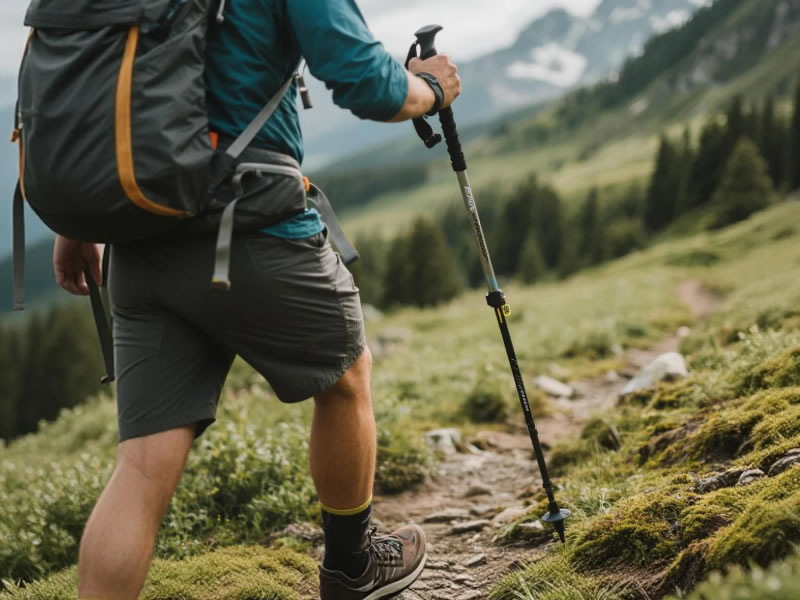
Recommended trekking pole purchase link: https://s.click.aliexpress.com/e/_c4M7OWaN
The Long‑Distance Paradigm: Weight Is King, But Not Everything
| Priority | Why It Matters for Long Trails |
|---|---|
| Weight | 10 oz vs. 18 oz per pair may seem trivial, but over 2,500 miles you will lift those poles millions of times. Heavier poles accelerate arm and shoulder fatigue. |
| Comfort | Grips that cause hotspots or straps that chafe will become unbearable by week two. |
| Packability | When poles are not needed (road walks, town stops), they must collapse small enough to stow securely on your pack. |
| Reliability | A lock that slips or a tip that wears out mid‑trail is a crisis. Replaceable components are essential. |
| Adjustability | Terrain varies constantly. Poles that adapt quickly to climbs, descents, and side‑hills keep you efficient. |
1. Shaft Material: Carbon Fiber Takes the Crown
For long‑distance hiking, carbon fiber is the undisputed champion.
- Weight savings: Quality carbon poles weigh 30‑40% less than equivalent aluminum models. Over a 20‑mile day, this translates to tons of lifted mass.
- Vibration dampening: Carbon absorbs trail chatter, reducing hand fatigue on long, monotonous stretches.
- The trade‑off: Carbon is more brittle than aluminum. A sharp lateral impact (e.g., jamming the pole between rocks) can cause a crack or snap. However, modern high‑modulus carbon used in reputable brands is remarkably resilient. For the vast majority of long‑distance hikers who stay on trail, the weight benefit far outweighs the fracture risk.
When to choose aluminum: If your route involves significant off‑trail scrambling, technical climbing, or you are exceptionally hard on gear, consider premium 7075 aluminum poles (e.g., Black Diamond Trail Pro). They are heavier but virtually indestructible.
2. Locking Mechanism: FlickLocks or Folding?
Long‑distance poles fall into two categories:
A. Folding (Z‑Pole) Design
- How it works: Sections are connected by an internal tension cord; poles fold into three or four segments.
- Pros: Extremely packable (collapse to ~35‑40cm), very light, simple (no external locks to fail).
- Cons: Length is fixed—you cannot adjust for steep terrain. Some models offer limited adjustability via a small extension section.
- Best for: Hikers on moderate, rolling terrain who prioritize packability and weight savings over on‑the‑fly adjustability.
Top pick:Black Diamond Distance Carbon Z – The gold standard. Ultralight (341g/pair), incredibly compact, and trusted by thru‑hikers worldwide. Available with or without FlickLock (the FLZ version adds a small adjustable section).
B. Telescoping (Adjustable) with External Lever Locks
- How it works: Sections slide inside each other; clamped by cam levers (FlickLock, Speed Lock).
- Pros: Infinite adjustability – shorten for climbs, lengthen for descents, fine‑tune for perfect ergonomics. Locks are field‑serviceable with a hex key.
- Cons: Slightly heavier than Z‑poles; longer collapsed length.
- Best for: Hikers who encounter significant elevation change and demand perfect pole length for every grade.
Top pick:LEKI Micro Vario Carbon – Combines a carbon shaft, a folding design, and a Speed Lock 2 adjuster on the lower section. Best of both worlds: packs small, adjusts easily. Weighs ~460g/pair.
3. Grip and Strap: The All‑Day Interface
| Grip Material | Long‑Distance Verdict |
|---|---|
| Cork | Ideal. Molds to your hand, wicks sweat, remains grippy when wet, reduces vibration. |
| Foam (EVA) | Good. Soft, comfortable, absorbs moisture. May compress and degrade over thousands of miles. |
| Rubber | Avoid. Heavy, slippery when sweaty, transmits vibration. |
Strap requirement: Wide, padded, and easily adjustable. You will be pushing through the strap for months; a narrow unpadded strap will cause circulatory issues and discomfort.
4. Tips and Baskets: Replaceability Is Key
Long‑distance hiking destroys tips. The best poles use screw‑in carbide tips that can be replaced when worn—typically after 500‑800 miles. Verify that replacement tips are readily available for your chosen model.
Baskets: Most thru‑hikers remove the small summer baskets entirely to save grams and reduce snagging. However, if your route includes snow or deep mud, ensure your poles accept interchangeable snow baskets.
5. Top Recommendations for Long‑Distance Hiking
| Model | Type | Weight (pair) | Adjustability | Grip | Best For |
|---|---|---|---|---|---|
| Black Diamond Distance Carbon Z | Folding (Z) | 341g | Fixed length (5cm range on FLZ) | Foam | Ultralight purists; rolling terrain |
| LEKI Micro Vario Carbon | Folding + Adjustable | ~460g | Speed Lock 2 (continuous) | Cork | Hikers who want packability and on‑trail adjustment |
| Cascade Mountain Tech Carbon | Telescoping | ~480g | External lever lock | Cork | Budget‑conscious long‑distance hikers |
| Black Diamond Alpine Carbon Cork | Telescoping | 500g | FlickLock Pro | Cork | Maximum adjustability; premium build |
| Komperdell Carbon Explorer | Telescoping | 490g | Power Lock 3 | Cork | Solid mid‑range alternative |
6. The Thru‑Hiker’s Wisdom: What Actually Matters
1. Weight trumps all.
Successful thru‑hikers consistently gravitate toward the lightest pole they can afford without sacrificing essential reliability. The Black Diamond Distance Carbon Z is ubiquitous on the PCT and AT for this reason.
2. Adjustability is a trade‑off.
Many thru‑hikers choose fixed‑length Z‑poles and accept that they will be slightly too long on steep climbs and slightly too short on steep descents. They argue that the weight savings and packability are worth the compromise. Others—especially those with knee concerns—insist on adjustable poles for optimal joint protection.
3. Spare parts are essential.
Carry a spare set of carbide tips and, if using lever‑lock poles, a small hex key to tension the cam. A broken tip or a loose lock on day 30 does not need to end your hike.
4. Break them in before the trail.
Do not start a 500‑mile walk with fresh, untested poles. Take them on several day hikes to verify comfort, adjustability, and that no manufacturing defects exist.
Conclusion: The Best Pole Is the One You Forget You’re Carrying
After 1,000 miles, the “best” walking pole is not the one with the flashiest features or the most expensive carbon weave. It is the pole that disappears—that becomes an extension of your body, requiring no conscious thought, no fidgeting with stuck locks, and no accommodation for discomfort.
Black Diamond Distance Carbon Z offers the ultimate expression of this philosophy: ultralight, simple, and perfectly adequate for the vast majority of long‑distance terrain. LEKI Micro Vario Carbon provides a thoughtful compromise for those unwilling to sacrifice adjustability. And Cascade Mountain Tech Carbon proves that you do not need to spend $200 to get a lightweight, comfortable, reliable pole.
But regardless of which you choose, the most important feature is this: it must make you want to keep walking.
Because on a long‑distance trail, the poles are not the destination. They are simply the tools that carry you there. Choose wisely, and they will carry you all the way.




