




What Size Walking Poles Do I Need? The Complete Sizing Guide
Determining the correct size for walking poles is the single most important factor in deriving benefit from them. Poles that are too long compromise leverage and posture; poles that are too short fail to protect your joints and provide inadequate stability. Yet sizing is not a one‑time calculation—it depends on your height, the terrain you walk, and even the type of walking you do. This comprehensive guide provides multiple methods for finding your ideal size, explains how to adjust for different conditions, and ensures you get the perfect fit for your body and your adventures.
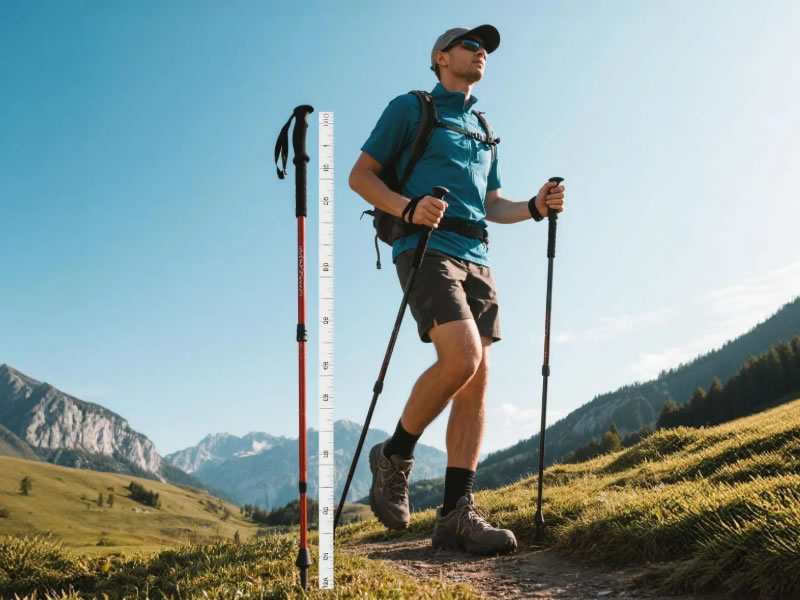
Recommended trekking pole purchase link: https://s.click.aliexpress.com/e/_c4M7OWaN
Method 1: The 90‑Degree Rule (Gold Standard)
For walking on flat terrain, the correct pole length is determined by a simple biomechanical test:
- Stand upright on a level surface wearing your typical walking shoes.
- Grip the pole handle as you normally would.
- Place the tip on the ground beside your foot.
- Your elbow should form a 90‑degree angle. Your forearm should be parallel to the ground.
Why this works: This position allows for an efficient arm swing, optimal power transfer, and neutral wrist posture. It is the reference point from which all other considerations flow.
If you do not have a 90° angle:
- Elbow >90° (arm too straight) → Pole is too long; shorten it.
- Elbow <90° (arm too bent) → Pole is too short; lengthen it.
Method 2: The Height Formula (Quick Reference)
If you cannot physically test poles, a general formula provides a reliable starting point:
Pole Length (cm) = Your Height (cm) × 0.68
Example: A 175 cm (5'9") hiker: 175 × 0.68 = 119 cm
Height to Pole Length Quick Reference:
| Your Height | Approximate Pole Length |
|---|---|
| 150 cm (4'11") | 102 cm |
| 155 cm (5'1") | 105 cm |
| 160 cm (5'3") | 109 cm |
| 165 cm (5'5") | 112 cm |
| 170 cm (5'7") | 116 cm |
| 175 cm (5'9") | 119 cm |
| 180 cm (5'11") | 122 cm |
| 185 cm (6'1") | 126 cm |
| 190 cm (6'3") | 129 cm |
| 195 cm (6'5") | 133 cm |
Important: This is a starting point, not a substitute for the 90‑degree test. Individual proportions (torso vs leg length, arm length) vary.
Method 3: The "Armpit" Test (Rough Estimate)
A very rough estimate: when the pole tip is on the ground and you grip the handle, your elbow should be at waist level. This is less precise than the 90° rule but useful for quick checks.
Adjustable vs Fixed‑Length Poles
Your choice of pole type affects how you approach sizing.
Adjustable (Telescoping or Folding with Adjustment)
- Advantage: You can fine‑tune length for different terrains, share poles with others, and accommodate changes in footwear (e.g., winter boots).
- Sizing method: Use the 90° rule to set your baseline. Then adjust dynamically as described below.
- Best for: Hikers who encounter varied terrain, backpackers, anyone unsure of their exact preferred length.
When choosing adjustable poles: Ensure the adjustment range includes your calculated size. Most adjustable poles cover approximately 65–135 cm, accommodating nearly all adults.
Fixed‑Length Poles (including most folding/Z‑poles without adjustment)
- Advantage: Lighter, simpler, more packable, fewer failure points.
- Sizing method: You must choose a single length that works for most of your walking. Use the 90° rule or formula to select.
- Best for: Fitness walkers on predictable terrain, ultralight hikers, those who prioritize packability over on‑trail adjustability.
If choosing fixed‑length poles:
- Err on the slightly shorter side if you anticipate more climbing.
- Err on the slightly longer side if you anticipate more descending.
- Many manufacturers offer size ranges (e.g., S, M, L) based on height. Consult their size chart.
Dynamic Adjustment: Matching Length to Terrain
For adjustable poles, your baseline length is just the beginning. You must adapt as the trail changes to maximize comfort, efficiency, and joint protection.
| Terrain | Adjustment from Baseline | Why |
|---|---|---|
| Flat | None (90° elbow) | Optimal for efficient, rhythmic walking. |
| Uphill | Shorten 5–10 cm (2–4 inches) | Allows you to plant closer to your body, maintain upright posture, and generate powerful push‑off. |
| Downhill | Lengthen 5–15 cm (2–6 inches) | Enables planting ahead of your body, creating a braking action that reduces knee impact and improves stability. |
| Sidehill | Uphill pole shorter; downhill pole longer | Keeps shoulders level; downhill pole acts as outrigger. |
| Stream crossing | Lengthen 5–10 cm | Provides extra reach to probe streambed ahead. |
| Deep snow / mud | Lengthen 5–10 cm | Prevents basket from sinking too deeply; use with large baskets. |
Commit to the habit: Adjust before every major terrain change. With quality flip locks, it takes seconds.
Special Considerations
1. Nordic Walking / Fitness Walking
For dedicated fitness walking on flat or rolling terrain, many users prefer fixed‑length poles sized precisely to the 90° rule. The emphasis is on a consistent, efficient gait, not terrain adaptation.
2. Heavy Backpacking
When carrying a significant load, you may benefit from poles that are slightly longer than your baseline on descents (up to the maximum recommended 15 cm) to provide extra braking force. On climbs, you may also prefer slightly shorter for powerful push‑off.
3. Seniors or Those with Balance Concerns
A slightly longer pole (1–2 cm above 90°) can provide a more upright, stable posture. Experiment carefully and prioritize stability.
4. Children
Children's poles should be adjusted more frequently as they grow. The 90° rule applies equally, but err on the side of slightly shorter to encourage good technique.
5. Winter Walking / Snowshoeing
With bulky winter boots or snowshoes, you may need to lengthen poles by an additional 5–10 cm beyond your summer baseline to account for the added height underfoot.
6. Injury or Rehabilitation
Individuals with specific joint issues may benefit from custom sizing. Consult a physiotherapist for personalized guidance.
Common Sizing Mistakes
| Mistake | Consequence | Correction |
|---|---|---|
| Poles too long | Hunched posture, shoulder strain, reduced leverage on climbs, increased risk of tripping. | Shorten to achieve 90° elbow on flat ground. |
| Poles too short | Over‑reaching, back strain, inefficient descents, inadequate knee protection. | Lengthen to 90°; consider slightly longer for descents. |
| Never adjusting for terrain | Missed knee protection on descents; inefficient climbing; unnecessary fatigue. | Adjust for every major terrain change. |
| Ignoring sidehill adjustments | Uneven arm position, reduced stability, increased fall risk. | Adjust each pole independently. |
| Using fixed‑length poles on highly variable terrain | Compromised efficiency and protection on significant climbs or descents. | Choose adjustable poles for variable terrain. |
| Assuming one size fits all | Poles sized for someone else will not fit you properly. | Always size for your own body. |
How to Test Your Sizing
At home or in a shop:
- Set poles to estimated length using formula or 90° test.
- Stand on level floor, tip on ground, elbow at 90°.
- Simulate a walking motion. Do your arms swing naturally? Do your shoulders feel relaxed?
- Check wrist strap fit—you should be able to bear weight through the strap, not your grip.
On the trail:
- After 10–15 minutes of walking, reassess. Do your hands, arms, or shoulders feel strained?
- On a climb, do you feel you have enough leverage? Can you plant and push effectively?
- On a descent, do you feel stable? Can you plant ahead and transfer weight?
Fine‑tune until it feels right. Comfort is the ultimate guide.
Summary: Quick‑Reference Card
| Situation | Pole Length |
|---|---|
| Flat terrain baseline | 90° elbow angle |
| Uphill climbing | Baseline minus 5–10 cm |
| Downhill descent | Baseline plus 5–15 cm |
| Sidehill traverse | Uphill pole shorter; downhill longer |
| Stream crossing | Baseline plus 5–10 cm |
| Deep snow/mud | Baseline plus 5–10 cm (with large baskets) |
| Nordic walking (fixed) | 90° elbow, no adjustment |
| Sharing poles | Mark your preferred settings with tape |
Conclusion: The Right Size Unlocks the Benefits
The question "What size walking poles do I need?" has a clear answer: the size that puts your elbow at 90° on flat ground, with the ability to adapt for terrain. This single measurement is the foundation of comfortable, efficient, and joint‑protective walking.
Start with the 90° rule. Use the formula as a check. Adjust for terrain. Listen to your body.
Properly sized poles are not a luxury—they are a necessity for anyone who wants to walk farther, safer, and with less strain. Take the time to get it right. Your knees, your shoulders, and your walking enjoyment will thank you for every mile.




