




Mechanical lock folding walking poles vs cord systems?
Folding trekking poles have revolutionized how hikers and travelers carry their gear. Two distinct design philosophies dominate this category: mechanical lock folding poles (which combine a folding Z‑pole with one or more external levers) and cord‑only folding poles (which rely solely on an internal elastic cord and button‑lock system). While both collapse into compact bundles, their differences in adjustability, reliability, repairability, and weight can significantly affect your experience on the trail. This deep dive explains the trade‑offs so you can choose the system that best matches your hiking style and maintenance preferences.
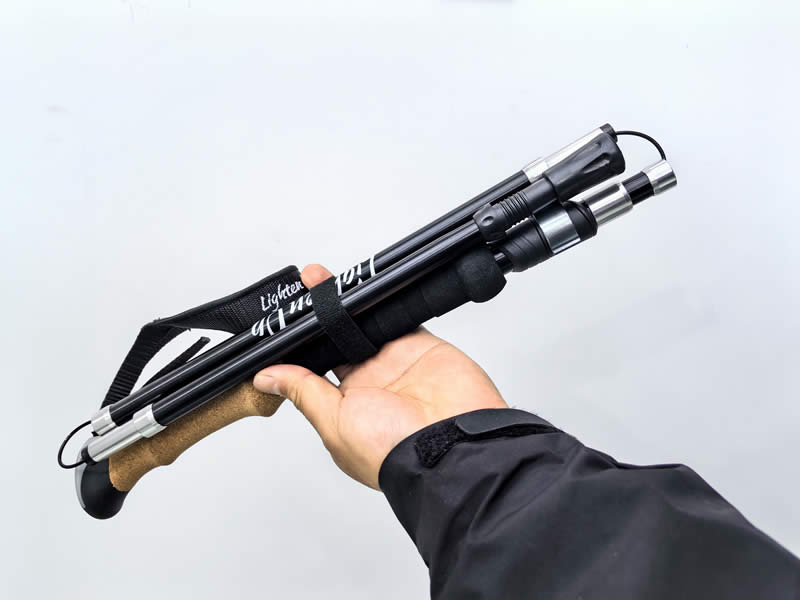
Recommended trekking pole purchase link: https://s.click.aliexpress.com/e/_c4M7OWaN
How Each System Works
Cord‑only folding poles (standard Z‑poles):
These poles consist of three (or sometimes four) sections connected by an internal elastic cord. When you pull the pole open, spring‑loaded buttons or internal cams snap into place, locking each section. To collapse, you press a release button (often on the top section) and push the sections together. The elastic cord keeps everything aligned and provides tension to help the buttons engage. This design has no external levers; all locking is internal. Classic examples include the Black Diamond Distance Z and Gossamer Gear LT5.
Mechanical lock folding poles (hybrid designs):
These poles combine the compact folding architecture of a Z‑pole with one or more external flick locks (mechanical levers). Typically, the upper sections fold (using a cord and buttons), while the lower section uses a flick lock for length adjustment. Some designs use two external locks and eliminate the internal cord entirely. Examples include the Black Diamond Z‑Pole with FlickLock and the Leki Micro Vario, which adds a Speed Lock lever to a 4‑section folding shaft.
Adjustability and Versatility
Cord‑only: Most cord‑only folding poles are fixed length. You choose a size (e.g., 110 cm, 120 cm) and the pole locks at that exact length. There is no on‑trail adjustment. This is fine if you hike consistent terrain and don’t use your poles for a shelter that requires precise height changes. Some cord‑only models offer a few centimeters of adjustability via a secondary button, but it is limited.
Mechanical lock: The presence of an external flick lock gives you genuine length adjustability—typically 10–20 cm of range. You can shorten the pole for steep climbs, lengthen it for descents, or dial in the exact height required for a trekking‑pole tent. This versatility is a major advantage for backpackers and technical terrain hikers.
Structural Rigidity and Reliability
Cord‑only: With no external hardware, these poles have a very clean, snag‑free profile. The internal locking buttons create a solid connection when properly engaged. However, the lack of adjustability means the pole’s length is fixed at the point where the sections meet; any wear in the button mechanism can lead to play or sudden collapse.
Mechanical lock: Adding an external lever introduces a potential snag point, but it also gives you a mechanism that is easy to inspect, adjust, and service. Flick locks can be tightened with a screwdriver if they loosen over time, and they provide a more positive, visible lock than a hidden button. For heavy loads or technical terrain, the mechanical lock offers greater confidence.
Repairability and Field Service
Cord‑only: If the internal cord breaks or a button fails, field repair is challenging. You may be able to replace the cord with a kit, but it requires disassembling the pole and re‑knotting the cord—a task best done at home. On the trail, a broken cord often means the pole is unusable until you can perform a repair.
Mechanical lock: If a flick lock loosens, you can tighten it with a multitool in seconds. If a lever breaks, replacement parts are widely available and can be installed without specialized tools. The mechanical lock system is inherently more user‑serviceable.
Weight and Packability
Cord‑only: These are generally the lightest folding poles. Without external levers, they shed every possible gram. The Gossamer Gear LT5, for example, weighs under 6 ounces per pair. Packed length is typically 16–18 inches for 3‑section models.
Mechanical lock: Adding one or two flick locks adds a small weight penalty—usually 1–2 ounces per pair compared to a cord‑only counterpart. Packed length is similar or slightly longer due to the lever mechanism, but many models still collapse to 16 inches or less (e.g., Leki Micro Vario folds to 15 inches).
Which System Should You Choose?
| Use Case | Cord‑Only | Mechanical Lock |
|---|---|---|
| Ultralight backpacking (fixed length OK) | ✓ Best | – |
| Thru‑hiking with a trekking‑pole tent | – | ✓ (adjustability needed) |
| Air travel / maximum packability | ✓ | ✓ (both pack small) |
| Heavy loads / technical terrain | – | ✓ (more robust lock) |
| Minimal maintenance desired | – | ✓ (easier to service) |
| Simplicity and fewer parts | ✓ | – |
The Verdict
Choose cord‑only folding poles if: Your primary goals are ultralight weight, simplicity, and you are comfortable with a fixed length (or a very narrow adjustment range). These poles excel for weight‑conscious hikers, trail runners, and anyone who sets their length once and forgets it.
Choose mechanical lock folding poles if: You need on‑trail length adjustability—whether for steep terrain, shelter pitching, or accommodating different users. The small weight penalty buys you versatility and easier field service, making them the preferred choice for backpackers, thru‑hikers, and travelers who want one pole to handle varied conditions.
Both designs offer excellent packability; the choice comes down to how much you value adjustability and repairability versus absolute minimum weight. With the right pick, your folding poles will be a reliable companion for years of adventures.




